Are you a podcaster who has spent months publishing episodes and still can't figure out why 98% of your listeners never make it to your website? Or maybe you're about to launch your first show and want to build something professional — without spending three weeks battling WordPress plugins?
After auditing 40+ podcast websites across genres over the last two years — from scrappy solo shows to eight-figure media brands — I can tell you that the sites which actually grow their audience don't succeed because of their color palette or the fancy parallax scroll. They succeed because they nail five specific jobs, in a specific order, every time.
In this guide, you'll get:
- The HEARD Framework — a 5-layer podcast website layout that every top-performing site uses
- 10 podcast website examples from 50K to 11M listeners per episode, each broken down by what to steal
- The 6 design mistakes that silently kill podcast audience growth
- A walkthrough of how to create a podcast website from scratch using Wegic's AI podcasts site builder — no templates, no plugins, no code
By the end, you'll have a clear blueprint — and a way to put it live today.
Why Your Podcast Needs a Website (The Numbers Make the Case)
Before the examples, a data anchor: there are currently over 619 million podcast listeners worldwide in 2026, up 6.83% year-over-year, per Backlinko's 2026 podcast statistics report — and 55% of Americans 12+ listen monthly. The podcast industry's global ad spend is projected to hit $4.46 billion in 2026, per eMarketer.
But here's the stat most podcasters miss: according to research cited by Beamly, podcast websites with clear branding and easy navigation see 32% higher listener engagement than shows relying solely on third-party platforms. And per Emergent's 2026 platform analysis, 48% of listeners say they discover new shows via search — in a browser, not an app.
That's the case. Spotify and Apple Podcasts handle distribution; your podcast website handles discovery, credibility, and audience ownership. Directories can change their algorithm tomorrow. Your website is yours.
The only question is: what makes a podcast website design that actually converts first-time visitors into loyal subscribers?
The HEARD Framework: 5-Layer Anatomy of a High-Converting Podcast Website
After auditing the top-performing podcast website examples across every major genre, every site doing real audience growth hits these five layers — in roughly this order on the page.

What each layer does — and why skipping any one of them costs you audience:
- H — Hero and player. The first thing a new visitor sees has to answer three questions in under five seconds: What is this show? Is it for me? Can I listen right now? A strong podcast homepage hero has your show name, a one-sentence description, and an embedded podcast player above the fold. If they have to scroll to find how to listen, most won't.
- E — Episode discovery. Your archive is your asset. A searchable, filterable episode library with individual episode pages and proper podcast show notes is what makes Google index your content — and what keeps returning listeners coming back. This is also the layer most responsible for podcast SEO.
- A — Audience capture. The hardest thing to rebuild after losing a platform is your audience. The podcast email list is your insurance policy — an owned channel no algorithm can touch. This layer also includes review prompts and community links.
- R — Revenue layer. Podcast monetization lives here: sponsorship landing pages, Patreon links, merch stores, premium content tiers, and donation widgets. Most beginner podcast sites skip this entirely until they "get big enough." That's exactly backwards — the infrastructure should be there from day one.
- D — Design and brand. Podcast branding is not about looking pretty; it's about making the show's personality legible through color, typography, and layout pace. A true crime show that looks like a corporate consultancy site loses listeners at the first scroll.
Every example below gets graded against these five layers.
3 Authority Podcast Website Examples (Expertise as the Hook)
1. Huberman Lab — The Deep-Content Science Site
Genre: Neuroscience & health · Episodes: 300+ · Avg length: 91 min · Platform: All major + YouTube · Type: Science authority site
Huberman Lab is the benchmark for science podcast website design in 2026. Rebuilt by digital agency DoubleUp in collaboration with the Huberman Lab team, the site was redesigned specifically to solve a discovery problem: listeners wanted to explore episodes by topic, not just chronologically. The result is a site organized around 22 topics and 90+ sub-topics — making a 300-episode library navigable for both superfans and first-time visitors.

HEARD grade:
- H — Hero: A (clean hero, latest episode prominent, Dr. Huberman's Stanford credentials immediately visible)
- E — Episode discovery: A+ (topic-based navigation, full-text search, show notes with timestamped protocols)
- A — Audience capture: A (Daily Blueprint email opt-in on every page — this alone reportedly became their top email signup source after launch)
- R — Revenue: B+ (newsletter cross-sell, no aggressive merch — deliberately understated for credibility)
- D — Design: A (clinical white, precise typography — the design is the authority signal)
What to steal: Organize by topic, not just by date. If your show has 30+ episodes, chronological archives become a wall to new listeners. Building even a simple tag/category system for your podcast show notes can increase time-on-site dramatically — and it's the single biggest podcast SEO unlock for long-running shows.
2. 99% Invisible — The Editorial Podcast Site
Genre: Design & architecture · Monthly downloads: ~1M+ · Type: Editorial storytelling + archive
Roman Mars's 99% Invisible is proof that a podcast website can feel like a magazine. Each episode has a rich editorial page — original photography, long-form show notes, transcripts, and links to every source cited. The podcast homepage rotates featured episodes with editorial headers rather than just listing dates and titles.

HEARD grade:
- H — Hero: A (current episode featured prominently, clean navigation, instant playback available)
- E — Episode discovery: A+ (500+ episode archive fully searchable, individual episode pages with full transcripts — a podcast SEO goldmine)
- A — Audience capture: A (newsletter with 600K+ subscribers, clear opt-in above the fold)
- R — Revenue: A (merch store, Patreon link, live event tickets all integrated cleanly)
- D — Design: A+ (muted palette, generous whitespace — podcast branding that matches the show's thoughtful, unhurried voice)
What to steal: Full transcripts on every episode page. Most podcast sites skip this entirely. Transcripts are the single highest-leverage podcast SEO investment available — they turn 60 minutes of audio into 8,000+ words of indexable text per episode. At 500 episodes, that's 4 million words of long-tail search content you're already sitting on.
3. The Tim Ferriss Show — The Blog-Podcast Hybrid
Genre: Business & self-improvement · Downloads: 900M+ total · Type: Long-form blog + podcast
Tim Ferriss built one of the world's largest podcast audiences on a website that looks, at first glance, more like a blog. Each episode gets a dedicated post with 3,000–8,000 words of show notes, an embedded player, and a full breakdown of every tool, book, and resource mentioned. The podcast homepage is a reverse-chronological feed of these rich posts — SEO-forward by design, not by accident.

HEARD grade:
- H — Hero: B+ (hero is functional not flashy — but his brand is so strong it doesn't need to be)
- E — Episode discovery: A+ (every episode is a fully indexed blog post — this is the podcast SEO stack that drove 900M total downloads)
- A — Audience capture: A (email list at 1M+ subscribers, prominent opt-in throughout)
- R — Revenue: A (book sales, affiliate tools, speaking, course promos — all woven into show notes)
- D — Design: B (deliberately minimal — the content is the design)
What to steal: Treat every episode as a long-form post, not just an audio file. Detailed podcast show notes with summaries, timestamps, guest bios, and resource lists turn a one-time listen into a Google-indexed, evergreen traffic source. This is the #1 gap in most podcast sites — and the easiest fix.
2 High-Personality Podcast Website Examples (Brand Voice as the Architecture)
4. Crime Junkie — Fan Community as the Core
Genre: True crime · Downloads: Top 5 globally · Producer: audiochuck · Type: Brand + community hub
Crime Junkie's podcast website design reads immediately: high-contrast black and dark red, bold typography, gripping episode summaries with thumbnail photography. But more important than the aesthetic is the structure — the site balances episode discovery, advocacy content (supporting related organizations), a merchandise store, and upcoming live-tour dates in a way that turns passive listeners into active community members.

HEARD grade:
- H — Hero: A (latest episode front-and-center, all subscribe links immediately visible across Apple, Spotify, YouTube, and more)
- E — Episode discovery: A (episode grid with visual summaries — easy to binge or revisit)
- A — Audience capture: A (audiochuck newsletter, members section with premium content)
- R — Revenue: A+ (merch store, live event tickets, membership — a textbook multi-stream podcast monetization model)
- D — Design: A+ (the dark, tense podcast branding is indistinguishable from the show's identity — every design choice earns its place)
What to steal: Your merch store and live event links belong in the main navigation, not the footer. Crime Junkie puts revenue-generating content at the same visual level as episodes — because merch and events are part of the fan experience, not an afterthought. Most independent podcasters bury their podcast monetization options where no one looks.
5. Song Exploder — Minimalism as the Statement
Genre: Music documentary · Type: Single-column archive, no sidebar, fully embedded players
Song Exploder is the rare podcast site that looks like nothing else in its genre — and that's entirely intentional. The podcast website layout is a single column of episode entries: artwork, title, guest name, and an embedded player. No sidebar. No pop-ups. No social proof strips. Every design decision removes friction between "landed on site" and "currently listening."

HEARD grade:
- H — Hero: A+ (the player is the hero — the entire site is built around immediate listening)
- E — Episode discovery: A (linear archive is simple but incredibly scannable; episode artwork carries all the discovery weight)
- A — Audience capture: B (newsletter exists but it's not pushed hard)
- R — Revenue: B (Spotify-exclusive deal handles monetization off-site)
- D — Design: A+ (the minimalism is the personality — it says "we care only about the music, nothing else")
What to steal: Match your podcast website layout to what your listeners actually come to do. Song Exploder's audience comes to listen — so the entire site optimizes for that one action. If your audience comes to read show notes or find guest resources, optimize for that instead. Design follows intent, not trend.
2 Business and Interview Podcast Website Examples (Authority + Conversion)
6. How I Built This (NPR) — The Network Authority Model
Genre: Entrepreneurship · Network: NPR · Type: Network-branded editorial site
How I Built This is part of NPR's podcast network, and its site reflects the institutional authority that brings: clean, editorial-grade layout, well-structured guest pages, and tight integration with NPR's broader content ecosystem. The podcast homepage puts the latest episode front and center alongside a curated "Start here" featured episode recommendation — a simple conversion pattern that dramatically improves episode-one completion rates for new listeners.

HEARD grade:
- H — Hero: A (latest episode + "start here" featured episode = two entry points for two listener types)
- E — Episode discovery: A (guest-based search, category filters, full show notes on every episode)
- A — Audience capture: A (NPR newsletter ecosystem, membership prompts)
- R — Revenue: A (NPR membership, sponsorship disclosures, structured sponsor pages)
- D — Design: A (authoritative sans-serif, high editorial credibility — podcast branding aligned with NPR's broader identity)
What to steal: Add a "Start Here" featured episode link to your podcast homepage. New listeners don't know which episode to try first. An explicit recommendation — not just the latest episode, but your best or most representative one — can increase new-listener conversion rates by guiding the uncertain visitor toward a confident first click.
7. My First Million — The Business Blog Hybrid
Genre: Business & entrepreneurship · Hosts: Shaan Puri & Sam Parr · Type: High-density episode + community
My First Million's site is a podcast website design built around business content density: each episode page includes detailed show notes, timestamped highlights, and resource links — plus a clear path to the hosts' newsletter and community. The podcast homepage feels more like a media company dashboard than a traditional podcast site, with clip highlights and recent episode cards arranged for rapid scanning.

HEARD grade:
- H — Hero: A (episode clip and play button immediate; host credibility visible)
- E — Episode discovery: A (episode cards with topic tags, search, guest archive)
- A — Audience capture: A (newsletter and community opt-in prominent on every page)
- R — Revenue: A (sponsorships, premium community tier, course promos)
- D — Design: B+ (functional and information-dense — the podcast branding is "smart business operators," not a visual statement)
What to steal: Put episode timestamps and key highlights inside the podcast show notes, not just the audio. Skimmable episode pages serve two audiences at once: the listener who wants to find a specific segment, and the Google crawler indexing your content for podcast SEO.
3 Independent Creator Podcast Website Examples (Solo Shows That Scale)
8. The Friday Habit — The Lead-Generation Podcast Site
Genre: Business & productivity · Type: Solo business show + email list engine
The Friday Habit is a masterclass in what a lean independent podcast site can accomplish. The podcast homepage has a clear hero CTA above the fold, a free guide opt-in that feeds the podcast email list, multiple CTA placements throughout the page, and a clean episode archive — all on a site built for a two-person show. There's a sticky header CTA so the subscribe action never leaves the viewport.

HEARD grade:
- H — Hero: A (CTA in hero and in navigation simultaneously — no ambiguity about what to do first)
- E — Episode discovery: B+ (episode archive present but transcript depth is limited)
- A — Audience capture: A+ (free guide opt-in is the first thing below the hero — this site treats email capture as the primary conversion, not plays)
- R — Revenue: B+ (book and coaching services integrated)
- D — Design: A (clean, friendly, responsive — the podcast branding communicates "approachable business coach" immediately)
What to steal: Use a free guide opt-in, not just "subscribe to my newsletter." "Join the newsletter" gets 1–3% conversion. "Download the free productivity system" gets 8–15%. The Friday Habit uses this to build a podcast email list that outperforms its raw download numbers.
9. Twenty Thousand Hertz — The Immersive Sound Design Site
Genre: Sound design & audio culture · Type: Immersive brand experience
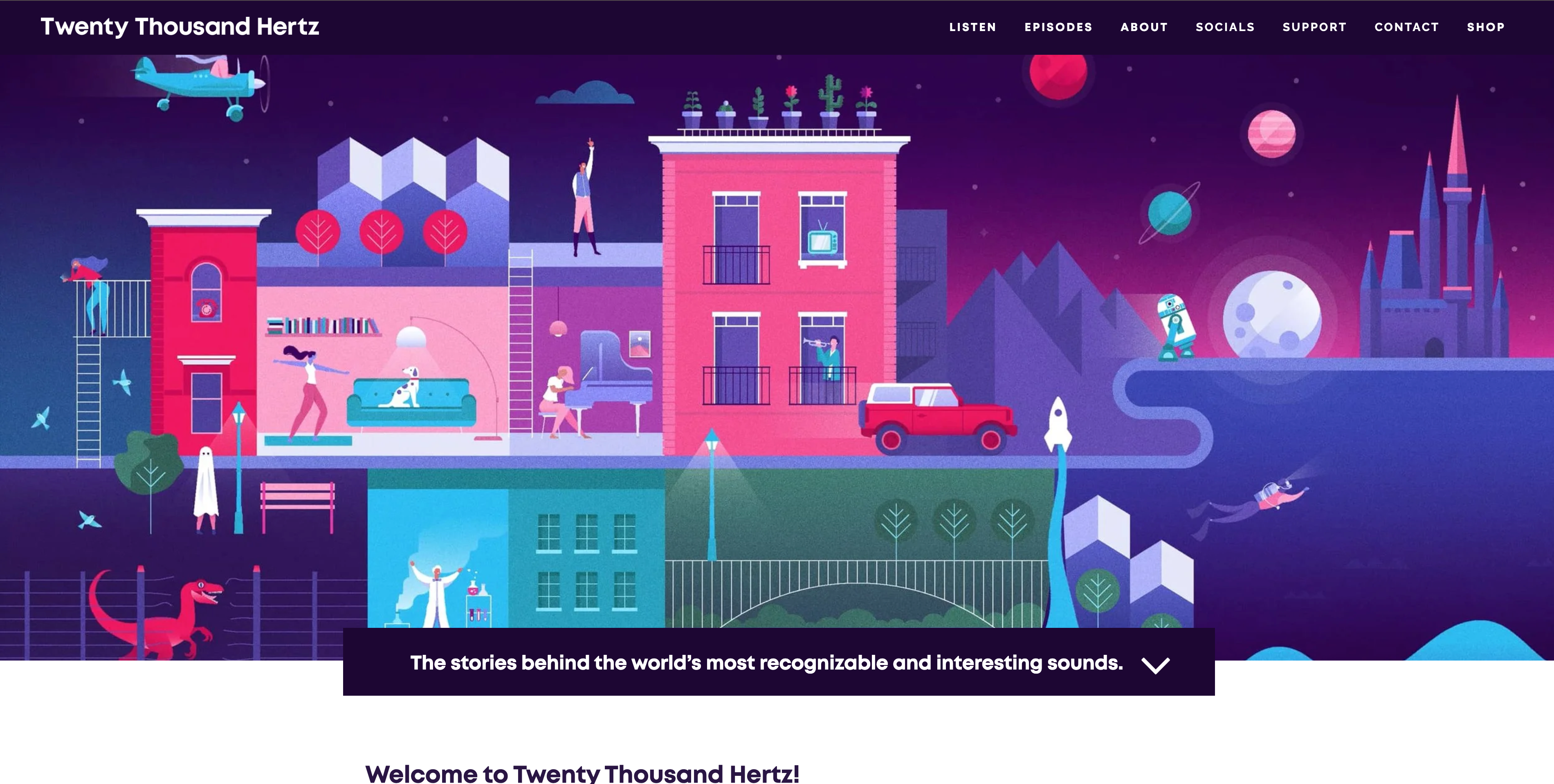
Twenty Thousand Hertz's podcast website design opens with a powerful brand quote — not an episode listing — creating an emotional hook before a single play button appears. Custom illustrations, a consistent sound-wave motif, and a parallax scroll make it feel like the audio experience starts at the homepage, not after pressing play.
HEARD grade:
- H — Hero: A+ (quote-first hero is a design risk that pays off — establishes the show's entire ethos in three seconds)
- E — Episode discovery: A (episode grid, clean navigation, subscribe links to all major platforms)
- A — Audience capture: A (newsletter opt-in prominently placed after the hero)
- R — Revenue: B (sponsorship info available, no direct monetization push)
- D — Design: A+ (the sound-wave illustrations and minimal color palette is the product — a textbook example of podcast branding done with visual restraint)
What to steal: Open with your show's point of view, not your latest episode. If your podcast has a clear philosophical position — what it stands for, who it's for, what it believes — leading with that in the hero converts first-time visitors more effectively than leading with show metadata. The listener decides to care about the show before they care about the episode.
10. The Popcast — Personality-Forward Pop Culture
Genre: Pop culture & comedy · Hosts: Knox & Jamie · Type: Dark, high-energy brand site
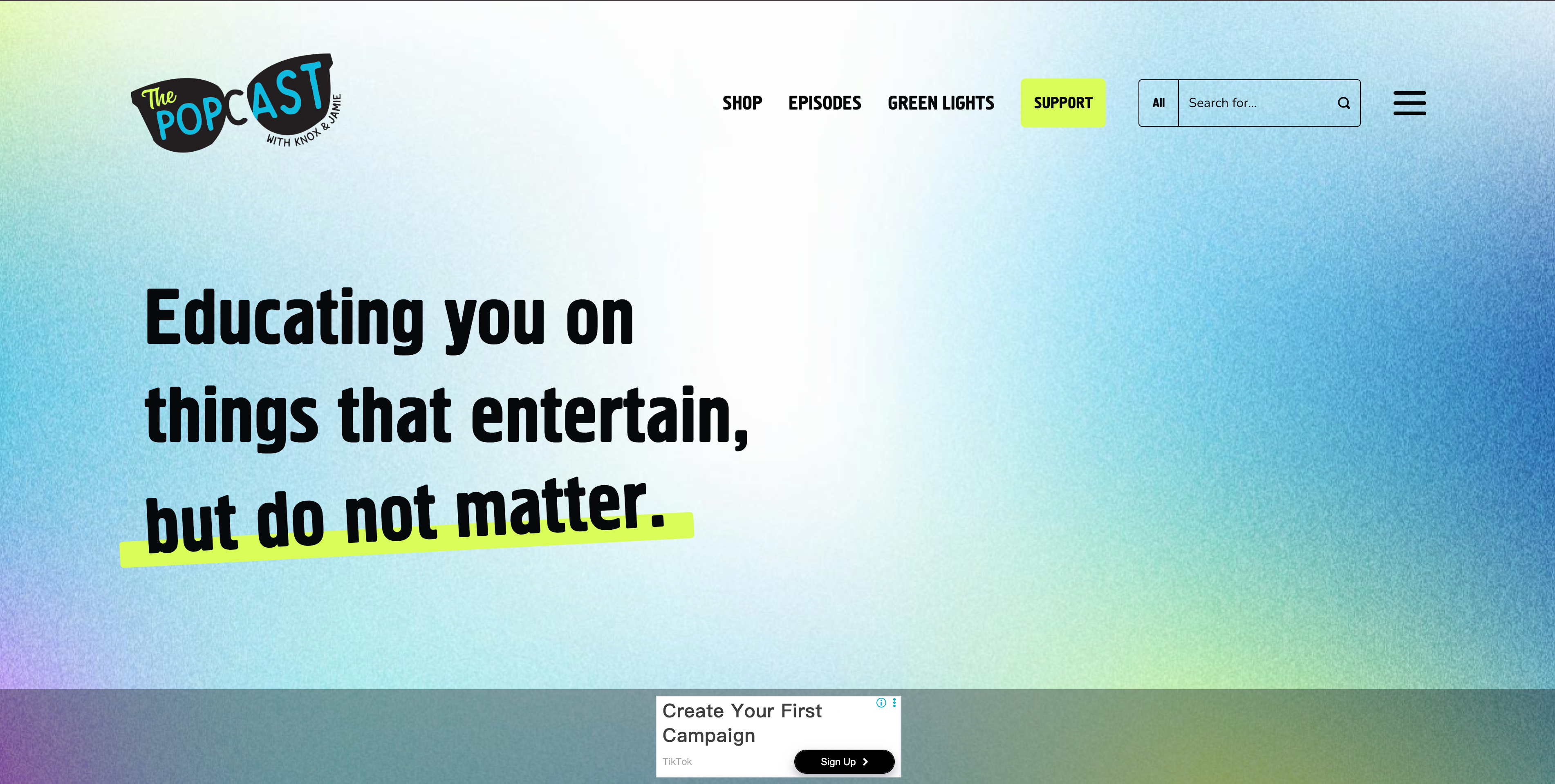
The Popcast site's podcast website layout is unambiguously fun: dark background, electric green accents, asymmetric sections, subtle page-transition animations. This is podcast branding at its most committed — every design decision communicates "we don't take ourselves too seriously, and neither should you." The site also integrates a Patreon link and merchandise prominently — podcast monetization baked in from the first scroll.
HEARD grade:
- H — Hero: A+ (immediately communicates the show's energy — you know if this is for you in 2 seconds)
- E — Episode discovery: B+ (episode grid functional, could use more searchability)
- A — Audience capture: B (social follow links prominent, email less so)
- R — Revenue: A (Patreon and merch in the main navigation — podcast monetization treated as a first-class feature)
- D — Design: A+ (typography, color, animation — every design decision earns its place and matches the show's voice)
What to steal: Your show's personality should be legible from your podcast homepage before a single word is read. The color palette, font weight, and spacing all communicate tone. A comedy podcast that launches with a minimalist white site loses its audience in the first scroll — they're looking for a show that matches their energy.
6 Design Mistakes That Quietly Kill Podcast Audience Growth
You can have the best episodes in your genre and still flatline if you make any of these. I see at least four of them on 8 out of 10 independent podcast sites I audit:
- No embedded podcast player on the homepage. Sending visitors to Spotify or Apple Podcasts to listen means sending them to a competitor platform where your call to action disappears. Embed the player. Keep them on your site. Per Elementor's 2026 podcast site guide, 65% of podcast consumption happens on mobile devices — and a sticky embedded player that works on mobile is the highest-ROI single addition to any podcast site.
- No individual episode pages. Publishing episodes without dedicated URLs means none of them are independently indexable. No indexable URLs = no podcast SEO. Every episode should have its own page with a title, description, podcast show notes, a transcript, and an embedded player.
- Skipping the podcast email list entirely. Spotify can de-list you. Apple can change their algorithm. YouTube can demonetize your channel. Your podcast email list is the only audience asset you fully own. Even a simple opt-in in exchange for a free episode guide is enough to start.
- Using a generic podcast website template without differentiating it. Off-the-shelf podcast website templates all share the same hero-player-episode-grid structure. When every show looks the same, none stand out. Differentiate with your brand voice, episode thumbnail style, and hero copy — not just colors.
- Burying podcast monetization in the footer. Patreon, merch, and premium content links belong in the main navigation — at the same level as "Episodes" and "About." If a listener finishes your show and wants to support you, they shouldn't have to hunt. Podcast monetization infrastructure should be visible before you think you need it.
- Ignoring podcast show notes depth. Short show notes ("Great interview with X about Y") are a missed opportunity for SEO and for listeners who find your site without having heard the episode. Detailed show notes — summaries, timestamps, resources, guest bios — turn a podcast page into a Google-friendly document and a genuine listener resource.
How to Build a Podcast Website in Minutes with Wegic
How to make a podcast website in 2026 shouldn't mean picking from twenty nearly identical podcast website templates, installing a WordPress plugin stack, or watching YouTube tutorials for three days. Wegic's conversational AI builder generates a complete, differentiated podcast site from a brief — the whole thing, in a single conversation.
Phase 1: Brief Kimmy with Your Show Identity
Open Wegic and chat with Kimmy, your AI project manager. The brief you give her maps directly to the HEARD Framework:
"Build a podcast website for a weekly true crime show called 'Casefile Decoded.' Dark color palette — near-black background with deep teal accents. Homepage hero with a one-sentence show description, embedded podcast player for the latest episode, and subscribe buttons for Spotify, Apple, and YouTube. Below that: a searchable episode grid with episode artwork and 100-word summaries. Then an email list opt-in offering a free 'Cold Case Starter Kit' PDF. In the footer: Patreon link and a merch coming-soon page. Every episode needs its own page with show notes, a guest bio section, and a transcript block for SEO."

Phase 2: AI-Generated Podcast Site in Under 60 Seconds
Wegic's GPT-powered engine reads your brief and generates a fully responsive, multi-page podcast site — not a rehashed podcast website template with your logo dropped in. In the same build, you get:
- A fully structured podcast homepage with hero, embedded player, and episode grid
- Individual episode page templates with show notes and transcript blocks
- Email opt-in section with custom free-resource framing
- Mobile-optimized layout where the embedded podcast player remains sticky on scroll
- Auto-generated sitemap and SEO metadata for podcast SEO from day one

Phase 3: Brand It by Conversation
Traditional podcast website builders force you into template-picker menus and color-swatch panels. Wegic lets you direct by description:
"Make the episode cards darker — I want them to feel more cinematic. Add a thin teal border on hover. Increase the font size on episode titles by 20%."
Wegic proposes 2–3 options with rationale before applying any change, so your mobile layout is never accidentally broken. For more on what Wegic's AI editing modes can do, the Wegic features page covers Comment Mode and sketch-to-edit in detail.
For additional inspiration on how top podcasters structure their supporting content, see our guide to website homepage examples and our breakdown of website landing page examples — both patterns apply directly to podcast podcast landing page design.

Phase 4: Publish in One Click — Hosting and SEO Included
Hit Publish. Wegic ships hosting, SSL, a custom domain option, auto-generated
sitemap.xml, and clean meta tags — your podcast site is live and indexable within minutes. The Wegic AI blog website builder topic page covers SEO defaults and content architecture that apply directly to podcast episode page structure.
Conclusion: The HEARD Framework Is the Only Blueprint You Need
The ten podcast website examples above span 50K to 11M listeners per episode, solo shows and network productions, clinical science and pop-culture comedy. None of them look alike. But every single one of them — the ones actually growing their audience — hits all five layers of the HEARD Framework with intention.
How to create a podcast website that actually grows your show is not a design question. It's a conversion architecture question: does your hero make it easy to listen? Does your episode archive make it easy to discover? Does your site capture email before a listener leaves? Does it give fans a way to support you? Does the design telegraph the show's personality before a word is read?
Answer yes to all five, and your podcast website design will outperform 95% of sites in any genre — no matter how small your audience is when you start. Start the conversation in Wegic today: you'll have the structure live before you finish your next episode.
FAQs
What should a podcast website include?
Every podcast website needs five core elements: an embedded podcast player or prominent listen/follow links above the fold, an episode archive with individual episode pages, podcast show notes with summaries and resources, an email opt-in to build your podcast email list, and clear subscribe links across all major platforms. Beyond those five, strong performers add full transcripts for podcast SEO, a guest page, a merch or Patreon link for podcast monetization, and an About section that builds host credibility.
How do I create a podcast website without coding?
The fastest path for how to make a podcast website in 2026 is a conversational AI builder like Wegic: describe your show, genre, and design preferences in plain language, and the AI generates a fully responsive, SEO-ready site in under 60 seconds — without templates, plugins, or code. Traditional podcast website builders like Squarespace and Wix also work, but require manual episode publishing and offer limited customization without coding. WordPress with dedicated podcast plugins (Blubrry, PowerPress) gives the most control but the highest setup time.
What makes a great podcast homepage?
A great podcast homepage answers three questions in the first scroll: what is this show, who is it for, and how do I listen right now? The best podcast homepages lead with a one-sentence show description, an immediately playable episode (via embedded player or prominent play button), subscribe links for all major platforms, and a clear next step — whether that's browsing the episode archive or entering an email for a lead magnet. According to Emergent's 2026 podcast platform research, sites with clear navigation and strong branding see 32% higher listener engagement than those relying solely on streaming directories.
Do I need a podcast website if I'm already on Spotify and Apple Podcasts?
Yes. Podcast directories handle distribution; your podcast website handles discovery, credibility, and audience ownership. Per Emergent's 2026 analysis, 48% of listeners discover new shows via web search — meaning a site with proper podcast SEO and indexed episode pages can deliver organic discovery that platform algorithms never will. More importantly, directories can change their algorithm or policies; your website and podcast email list are the only audience assets you permanently own.
How do I monetize a podcast website?
Podcast monetization through your website works across several models: direct listener support via Patreon, Ko-fi, or a native donation widget; merchandise through a built-in or linked store; premium content behind a paywall or membership tier; sponsorship pages where brands can apply to partner; and affiliate links embedded in podcast show notes. The highest-performing podcast sites treat monetization as a first-class navigation item — visible from the homepage, not buried in the footer.
What's the best podcast website design style?
There's no single best podcast website design — the right design matches the show's tone. Science and health podcasts (Huberman Lab) use clinical whites and precise typography to signal expertise. True crime shows (Crime Junkie) use dark palettes and high contrast to communicate tension. Comedy shows (The Popcast) use bold color, irregular layouts, and animation to signal energy. The rule is simple: a first-time visitor should be able to feel the show's personality from the podcast homepage before pressing play. If your design communicates the wrong genre, you're losing the right listener before they ever hear your voice.
How long does it take to build a podcast website?
With a traditional podcast website builder or WordPress setup, expect 1–3 days of setup, design, and plugin configuration before you have a functional site. With a conversational AI builder like Wegic, the full podcast website — homepage, episode archive template, email capture, and published with hosting — can be live in under 10 minutes from brief to publish. Either route, the most time-consuming part is writing your podcast show notes and episode descriptions — the AI handles the rest.