Are you trying to figure out how to build an affiliate marketing website and keep getting paralyzed by the choice between WordPress, Wix, Squarespace, and AI builders? Or maybe you already have a niche site doing $200/month and you're trying to figure out why it isn't scaling like the successful affiliate websites you keep reading about?
After teardown-auditing 30+ profitable affiliate marketing site examples in the home, finance, software, and travel niches over the last two years, I can tell you the difference between a $200/month side project and a $200,000/month operation is rarely traffic, design taste, or even keyword research. It's the Trust Stack — a five-layer pattern that every high-earning affiliate site shares, even when they look nothing alike on the surface.
In this guide you'll get:
- The Trust Stack framework — a 5-layer affiliate website layout used by every site earning $50k+/month
- 7 affiliate marketing website examples from $11K to $687M in annual revenue, each broken down by what to actually copy
- A direct look at the highest-earning affiliate marketing niches and the affiliate programs powering them
- The 5 conversion mistakes I see on 9 out of 10 affiliate marketing for beginners projects
- A walkthrough of how to launch a complete affiliate site in under 10 minutes using Wegic's conversational AI website builder
By the end, you'll know exactly which patterns are worth borrowing and which are dead weight.
Why Affiliate Websites Are a $20+ Billion Opportunity in 2026
Before the examples, some numbers to anchor every decision later in this guide:
- The global affiliate marketing industry is valued at $17–18.5 billion in 2025, projected to exceed $20 billion in 2026 and reach $71.74 billion by 2034 at a 15.2% CAGR, per Post Affiliate Pro's 2026 industry report.
- Over 90% of e-commerce businesses are expected to run affiliate programs by 2026, and 80% of brands already do, according to Cognitive Market Research data summarized by Hostinger.
- 78.3% of affiliate marketers cite SEO as their primary acquisition channel, per the Authority Hacker State of Affiliate Marketing survey — which is why every example below is built around organic search, not paid traffic.
- Affiliate marketing delivers an average ROI of 12:1, one of the highest across digital marketing channels.
- The top-earning affiliate marketing niches by average monthly income are Education ($15,551), Tech ($12,475), and Health & Wellness ($8,038) — niche choice is not a vanity decision, it's a math decision.
The takeaway: this isn't a side-hustle blip anymore. It's a maturing channel where the publishers who win are the ones who design for trust — not the ones who pump out the most "best X for Y" listicles.
Quick clarification: affiliate website vs. niche site vs. review blog
These terms get used interchangeably and the distinction does matter when you're planning structure. An affiliate website is any site monetized primarily through commissions on referred sales. A niche affiliate website is a narrower term — an affiliate site focused on one specific audience or topic (e.g. "ultralight backpacking gear for thru-hikers"). A review blog is a content format used inside both. In this guide, "affiliate marketing site examples" covers all three.
The Trust Stack: A 5-Layer Anatomy of Every High-Earning Affiliate Site
After teardown-auditing dozens of successful affiliate websites, every single one that earned over $50K/month had these five layers in place. Most failing sites are missing two or three. Think of it as the canonical affiliate website structure — get the layers in the right order and the rest of your affiliate marketing strategy becomes much simpler to execute.
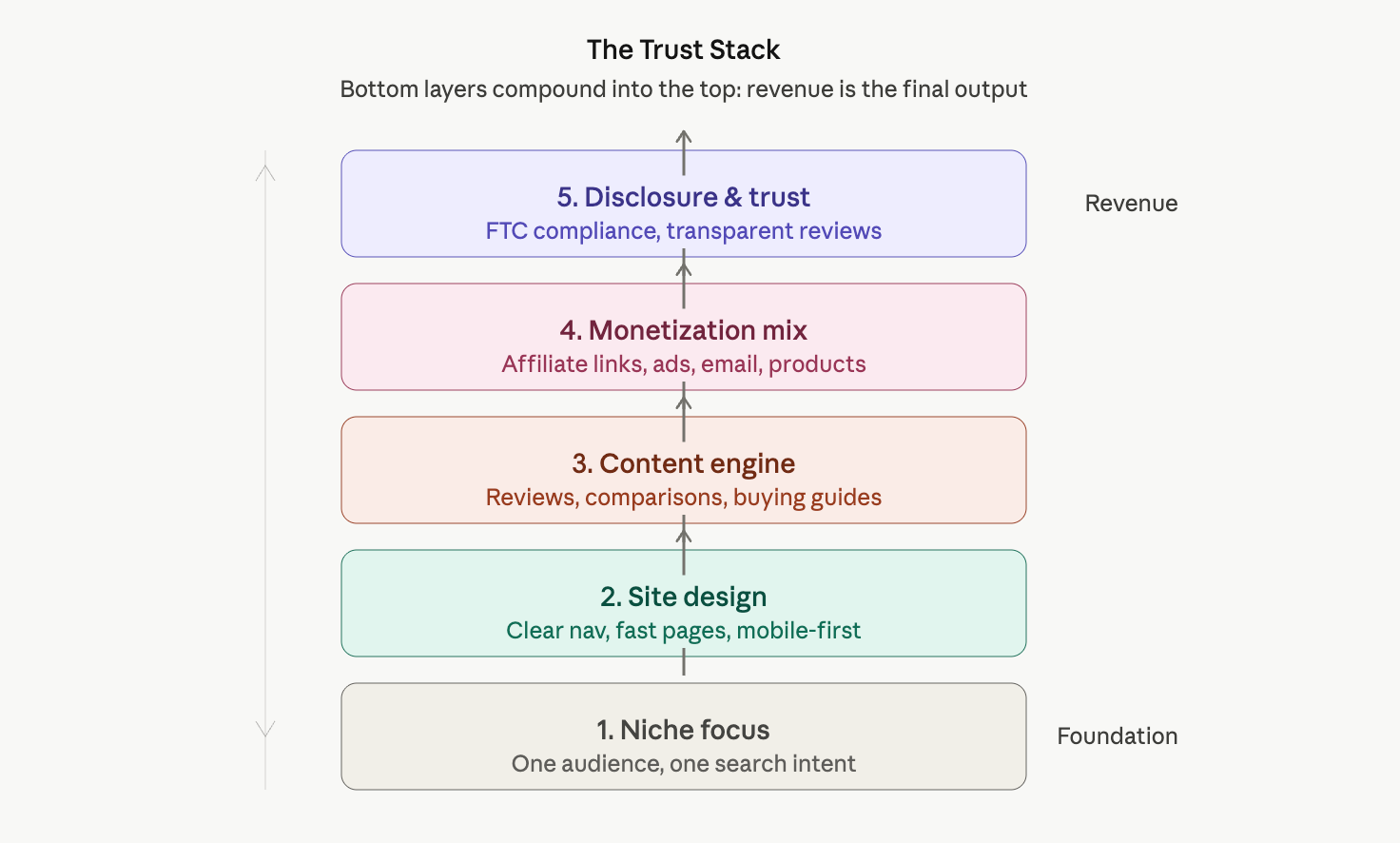
Here's what each layer does and why missing one kills the site:
- Niche focus — One audience, one buying intent. The narrower, the easier to rank and the higher the conversion. A niche affiliate website targeting "ultralight backpacking gear for solo thru-hikers" will out-earn a generic "outdoor gear" site every time, even with one-tenth the traffic.
- Site design — Clean navigation, fast load times, mobile-first. Good affiliate marketing website design isn't about looking pretty; it's about routing buying-intent traffic to commission-bearing pages without friction. Sites that fail Core Web Vitals lose ~50% of mobile traffic before the headline loads.
- Content engine — A repeatable mix of reviews, comparison guides, and how-to tutorials hitting bottom-of-funnel keywords. This is where commissions actually originate.
- Affiliate website monetization — Affiliate links are the spine, but the best sites layer in display ads, email captures, and sometimes their own digital products. Single-stream monetization is fragile; a layered affiliate website monetization mix protects you from any single program slashing commission rates.
- Disclosure & trust — FTC affiliate disclosure compliance, transparent methodology, real expertise. Without this layer, the bottom four collapse the first time a reader smells a fake review.
Every example below gets graded against this stack.
3 Niche-Specific Affiliate Marketing Website Examples (Expertise Wins)
1. Wirecutter — The Expertise Moat
Niche: Consumer product reviews (broad) · Estimated revenue: $150M+ between 2011–2016 before NYT acquisition · Type: Editorial affiliate site
Wirecutter is the platonic ideal of an affiliate marketing website. A team of journalists, scientists, and researchers test hundreds of products before recommending a single one. Their best-bath-mat review literally tests bath mats in a shower for weeks.
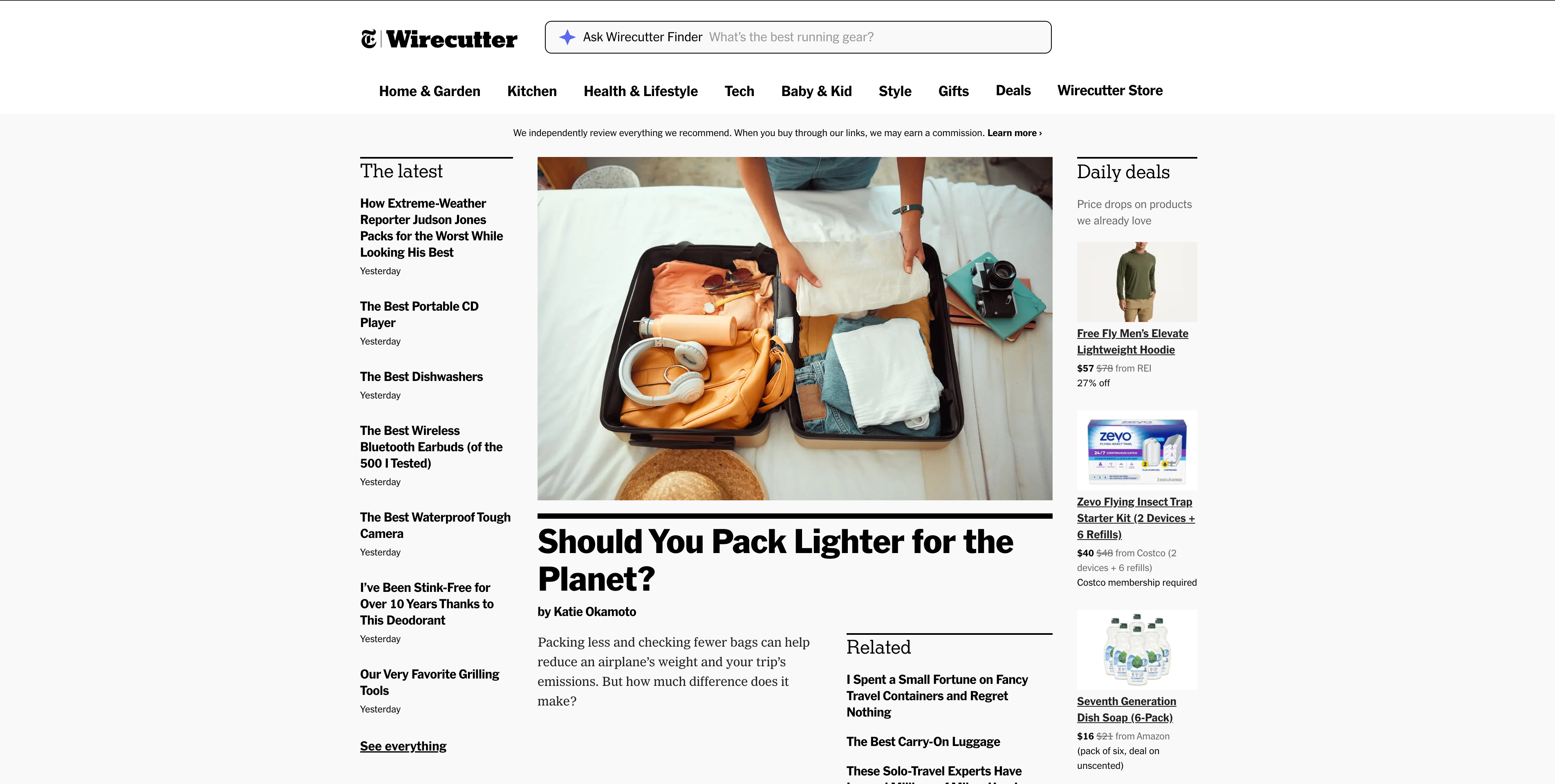
Image by Wirecutter (The New York Times)
Trust Stack grade:
- Niche focus: B (they're broad, but each individual review is hyper-narrow)
- Site design: A (clean editorial layout, table of contents on every review)
- Content engine: A+ (multi-week testing, comparison tables, "best for X" sub-picks)
- Affiliate website monetization: A (affiliate links + NYT subscription cross-sell)
- Disclosure: A+ (their FTC affiliate disclosure appears on the homepage, every article header, and a dedicated methodology page)
What to steal: Show your testing process. Don't just say "we tested 47 bath mats." Show the photo of you testing 47 bath mats. The visible methodology is what converts skeptical buyers — it's also a ranking signal Google explicitly rewards through E-E-A-T.
2. NerdWallet — The Decision-Engine Affiliate Site
Niche: Personal finance (credit cards, loans, mortgages) · Revenue: $687.6M in 2025 · Type: Editorial + comparison tool
NerdWallet stopped being "a blog" years ago. The homepage routes visitors straight into interactive comparison tools: credit card finders, mortgage calculators, savings rate checkers. Affiliate partnerships with issuing banks are the monetization, but the product is the decision engine.
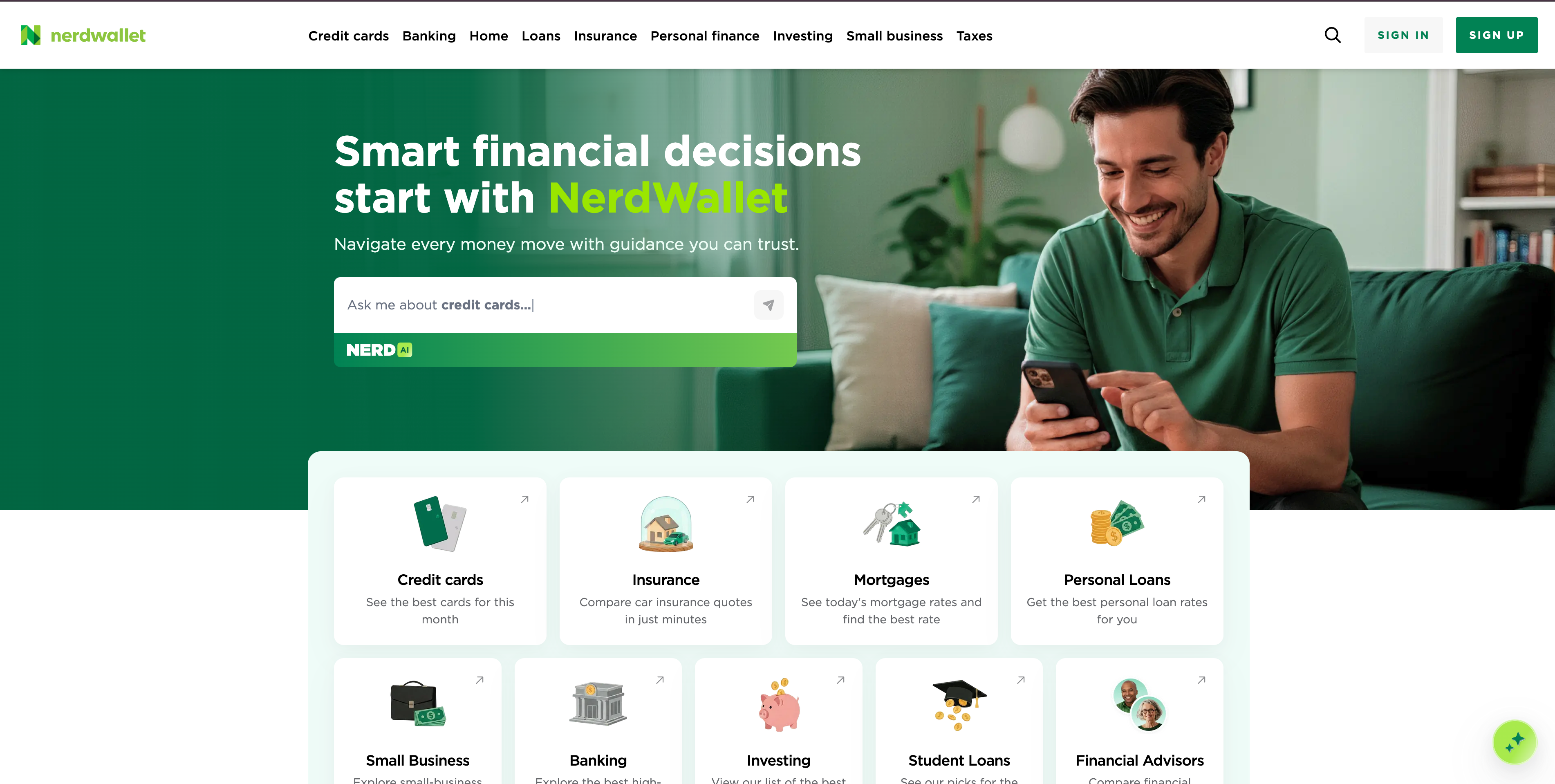
Image by NerdWallet
Trust Stack grade:
- Niche focus: A (one industry, deeply)
- Site design: A+ (the affiliate website layout uses tabbed navigation by financial product, plus sticky comparison tools)
- Content engine: A (every product has a long-form review and a calculator)
- Affiliate website monetization: A+ (multiple affiliate programs + lead-gen + their own card products)
- Disclosure: A+ (explicit "How we make money" page in main nav)
What to steal: Make your highest-converting page interactive. A comparison table that lets the user filter by their own criteria converts 2–3× better than a static "top 10" list. Even a simple sortable table beats a paragraph-heavy listicle. (See our guide to website navigation examples for how the best sites structure tools like this.)
3. Skyscanner — Search as the Affiliate Engine
Niche: Travel (flights, hotels, car rentals) · Traffic: ~11M monthly visits · Type: Price aggregator + content site
Skyscanner is a search-first affiliate site. The hero is a flight-search bar; affiliate revenue comes from airline, hotel, and car-rental partners who pay when bookings close. But the long tail of traffic comes from their travel blog — destination guides that quietly embed search widgets pre-filled with the relevant city.
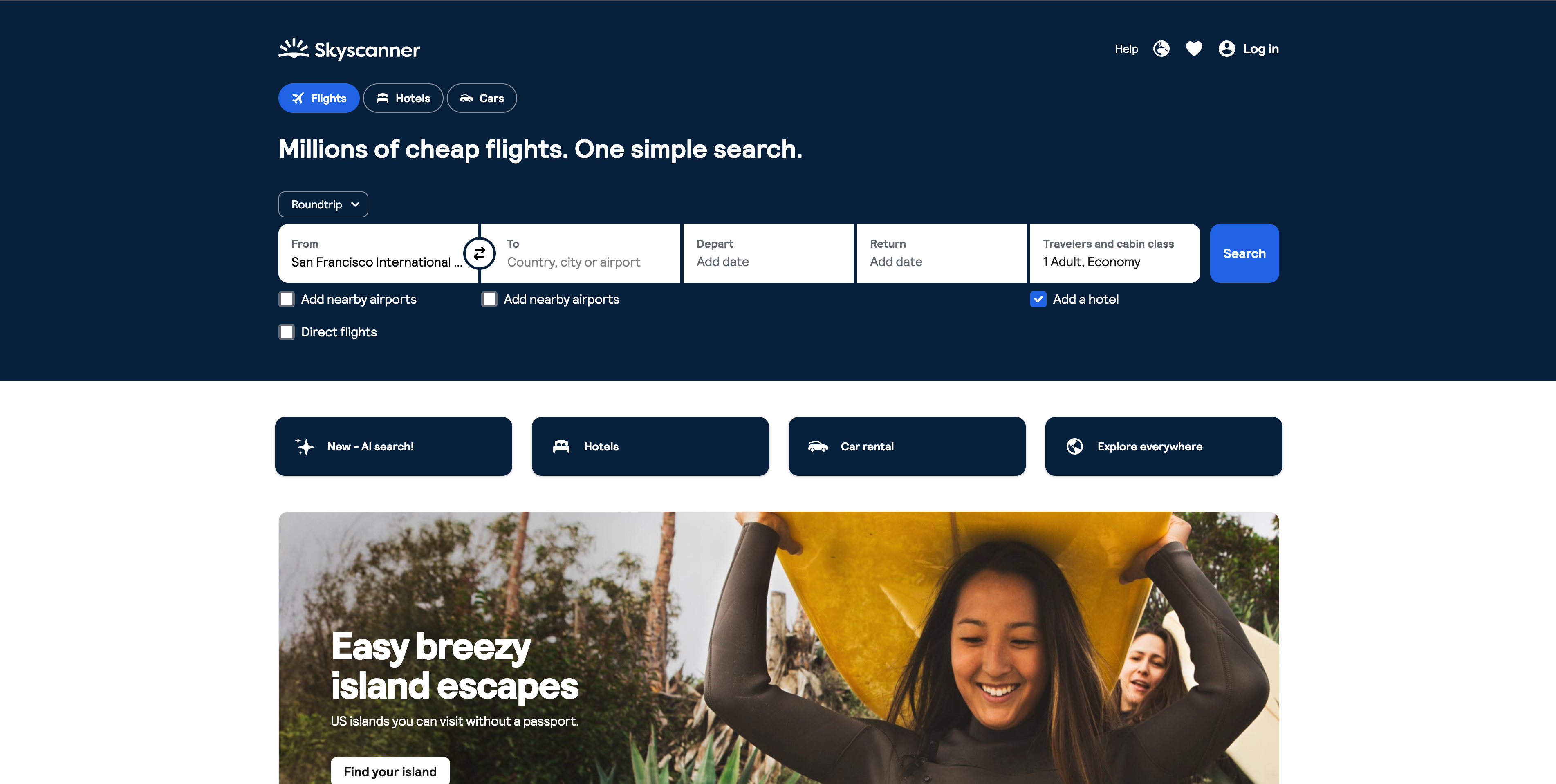
Image by Skyscanner
Trust Stack grade:
- Niche focus: A (travel, full stack)
- Site design: A (search is the hero, content is a secondary acquisition layer)
- Content engine: A (long-form destination guides + transactional landing pages)
- Affiliate website monetization: A (commission-based affiliate programs + their own ads + B2B affiliate channel via CJ/Awin)
- Disclosure: B+ (commercial relationships disclosed, but less prominent than NerdWallet)
What to steal: If your niche has a single high-intent action — booking, configuring, getting a quote — promote that interactive action to hero position. Don't bury it under a carousel. The lesson generalizes to almost any service-marketplace niche.
2 Solo Operator Affiliate Marketing Site Examples (Scale Without a Team)
Not every affiliate site has a 50-person editorial staff. The next two examples were built by individuals — proof that the Trust Stack works at every scale and that an Amazon affiliate website run by one person can absolutely compete with corporate publishers.
4. Epic Gardening — From One Person to 8 Figures
Niche: Home gardening · Traffic: ~1.3M monthly visits · Revenue: 8 figures annually · Type: Niche authority Amazon affiliate website
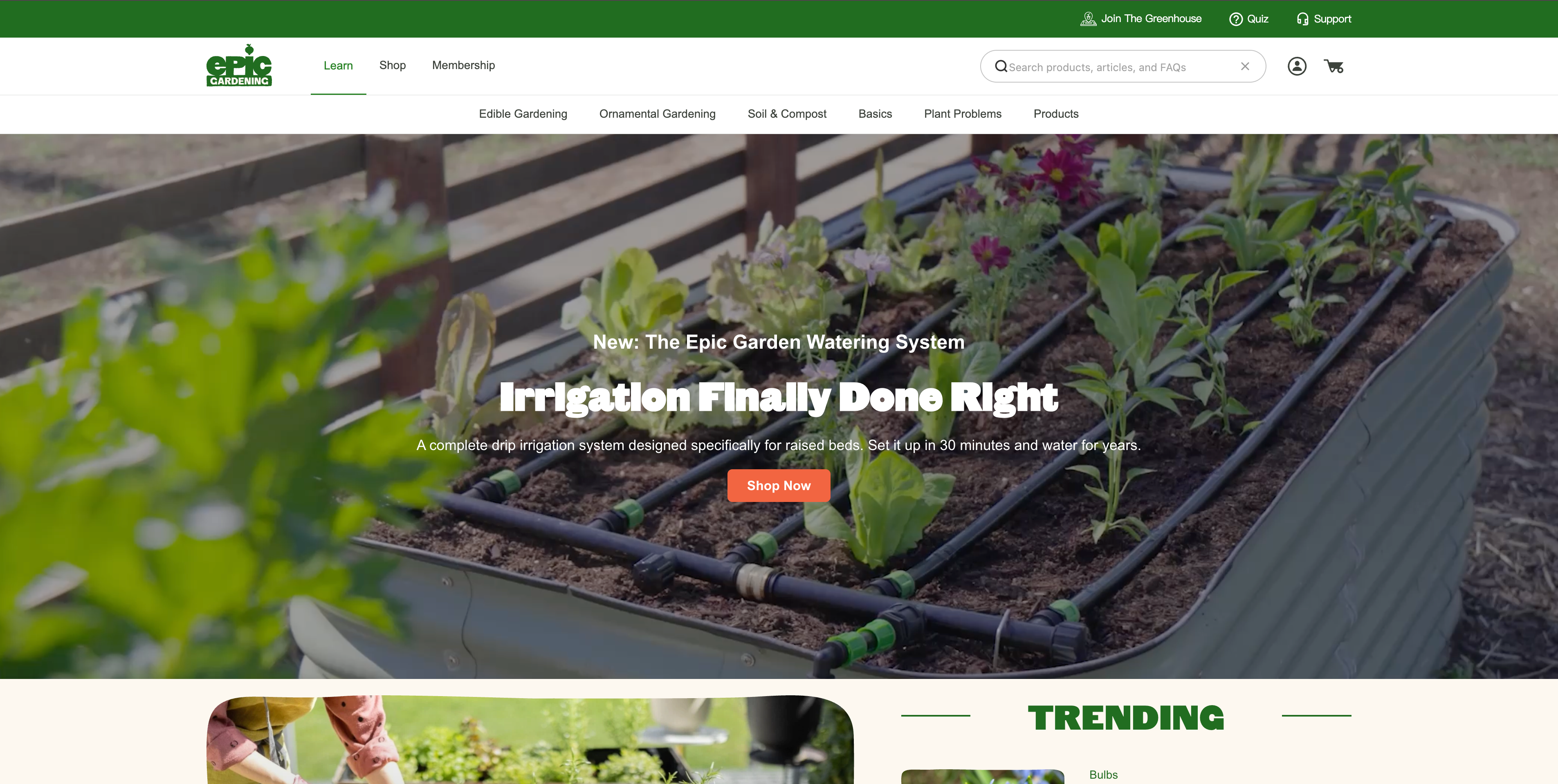
Epic Gardening began as one guy's gardening blog. It now drives over a million monthly visits and earns eight figures yearly — primarily through Amazon affiliate marketing links and direct brand partnerships. The growth lever wasn't more content; it was cross-platform compounding: 2M+ YouTube subscribers feeding traffic into review pages.
Trust Stack grade:
- Niche focus: A+ (urban food gardening — narrow, evergreen, high purchase intent)
- Site design: A (clean blog grid + product-display plugins)
- Content engine: A+ (how-to guides + plant-specific buying guides)
- Affiliate website monetization: A+ (Amazon Associates + courses + their own seed/soil brand)
- Disclosure: A (Amazon Associates FTC affiliate disclosure in every post header)
What to steal: Don't only blog. Pick one secondary channel — YouTube, Pinterest, or TikTok — and turn it into a content factory. This is the most under-used affiliate marketing strategy for solo operators; every video becomes a description-link traffic source for your affiliate posts. Skip it and you leave 60–70% of your potential traffic on the table.
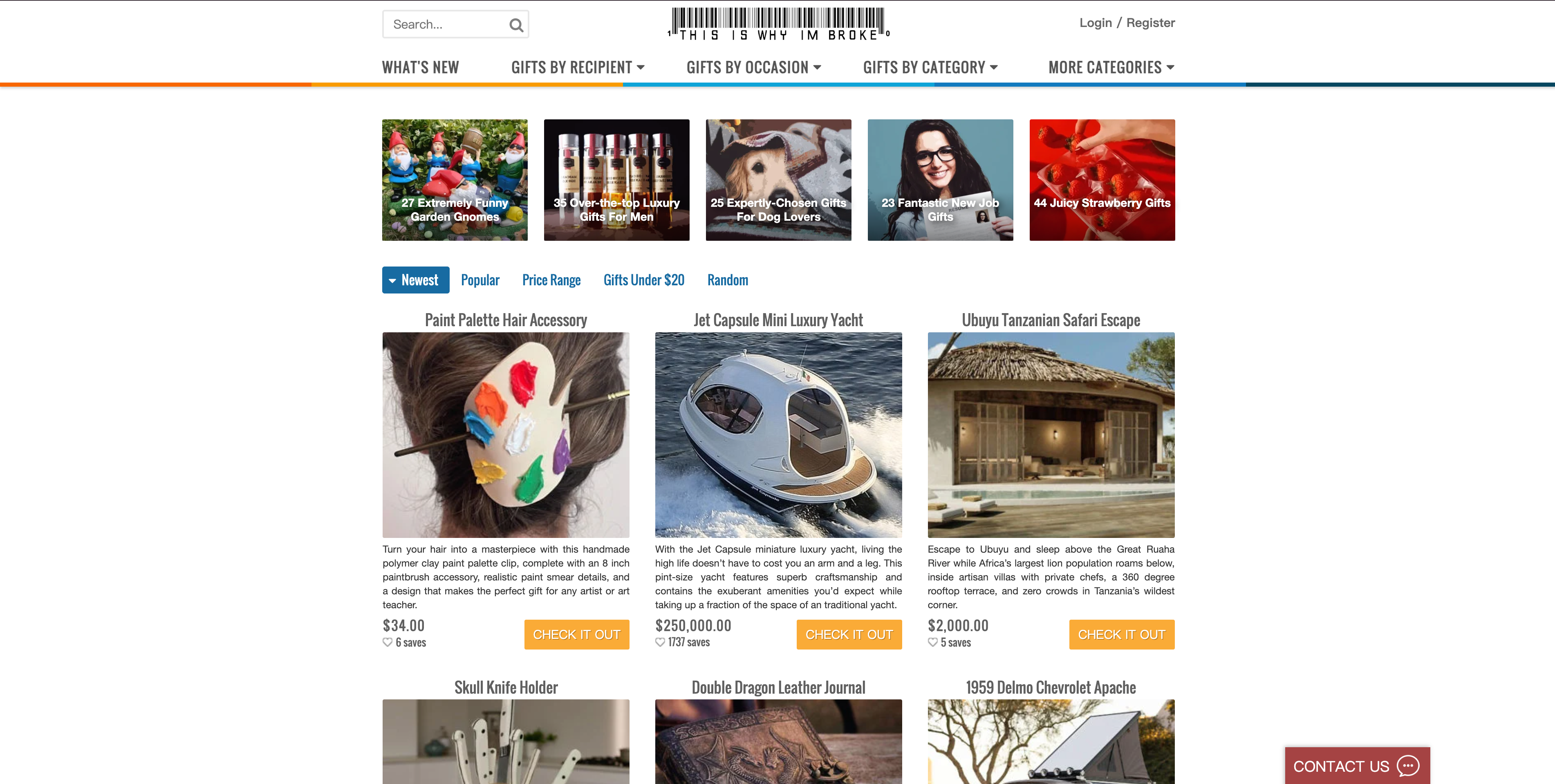
5. This Is Why I'm Broke — Personality as the Moat
Niche: Quirky and unusual products · Estimated value: $77M+ · Type: Curation-style Amazon affiliate website
This Is Why I'm Broke is the anti-Wirecutter. Instead of in-depth reviews, it curates bizarre and shareable products — toilet paper printed with politicians' faces, cat-face massagers, Godzilla fact books. The traffic engine is social shares, not SEO. The revenue engine is Amazon affiliate marketing, but the content moat is voice.
Trust Stack grade:
- Niche focus: A (one mood — "things you didn't know you needed")
- Site design: B+ (utilitarian product grid, but it fits the brand)
- Content engine: A+ (every product description is a punchline)
- Affiliate website monetization: B (heavy Amazon dependence, no email funnel)
- Disclosure: A (Amazon Associates disclosure visible)
What to steal: In a commodity niche, voice is your fastest moat. If your product descriptions could be lifted from the manufacturer's page, you've already lost to a thousand identical sites. Inject personality — even a 20% voice injection separates you from 95% of your category. (See our breakdown of creative website design examples for more on personality-driven brand design.)
2 Modern Affiliate Marketing Website Examples (B2B & Creator Niches)
The final two examples reflect where affiliate marketing website design is moving in 2026 — high-ticket B2B SaaS partnerships and creator-led personal-brand sites.
6. PCPartPicker — The Tool-Driven Affiliate Site
Niche: PC building components · Type: Interactive comparison + affiliate
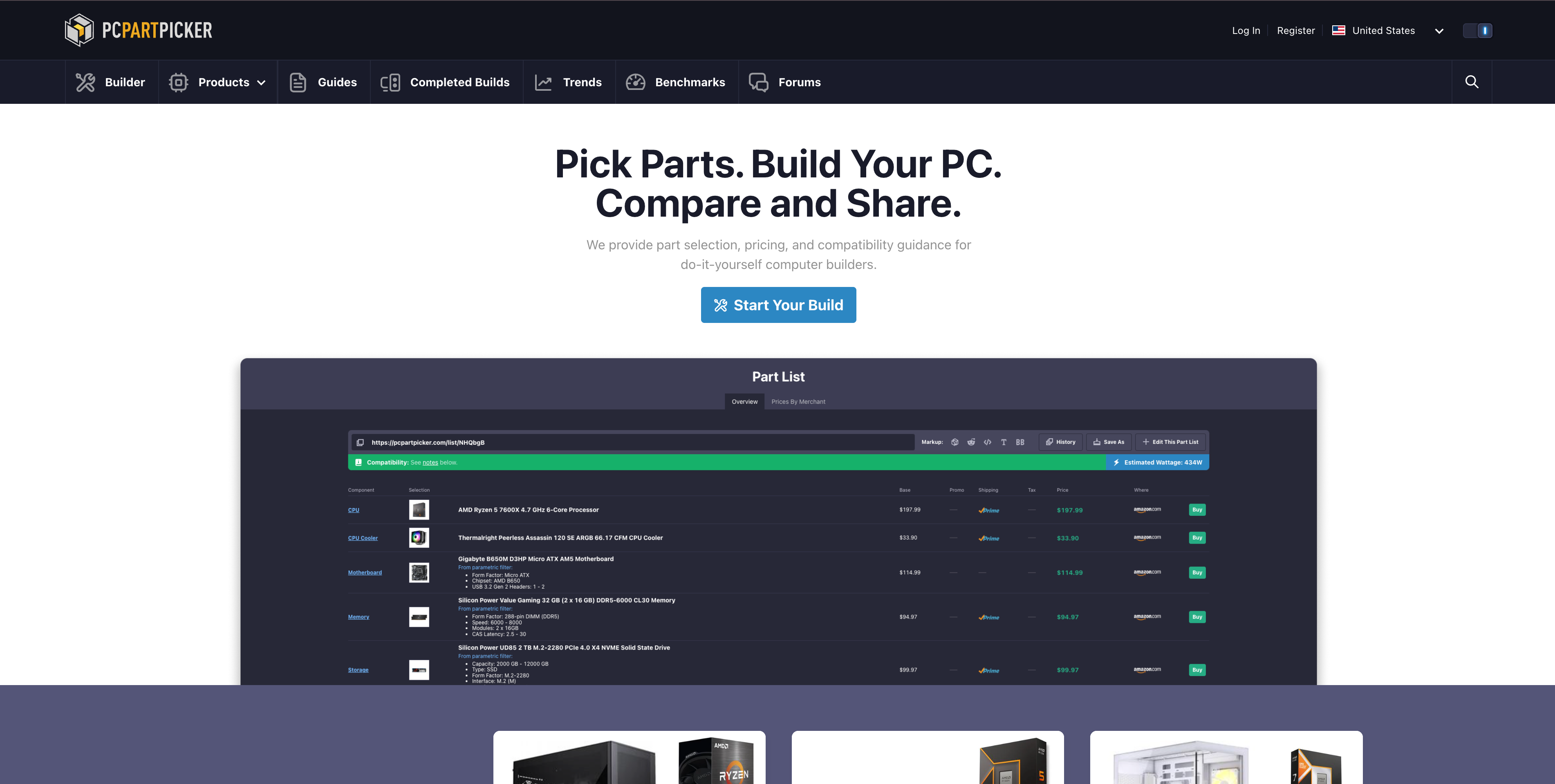
PCPartPicker doesn't have "10 best CPUs in 2026" listicles. It has a part-compatibility tool. You build your dream PC, the tool tells you which parts work together, and every selected component links to retailers (Amazon, Newegg, B&H) where PCPartPicker collects commission.
Trust Stack grade:
- Niche focus: A+ (one task — building a PC)
- Site design: A+ (the comparison tool is the homepage)
- Content engine: B (user-generated builds + guides, lighter on editorial)
- Affiliate website monetization: A (multi-retailer affiliate programs + builder tool subscriptions)
- Disclosure: A (clearly labeled affiliate badges next to retailer links)
What to steal: Interactive tools are the highest-converting form of affiliate content in 2026. If your niche has any "configuration" or "compatibility" problem — even a simple calculator — building it once outperforms 100 review articles forever.
7. The Points Guy (TPG) — The Editorial Authority Play
Niche: Travel rewards, credit cards · Type: Editorial publication + affiliate
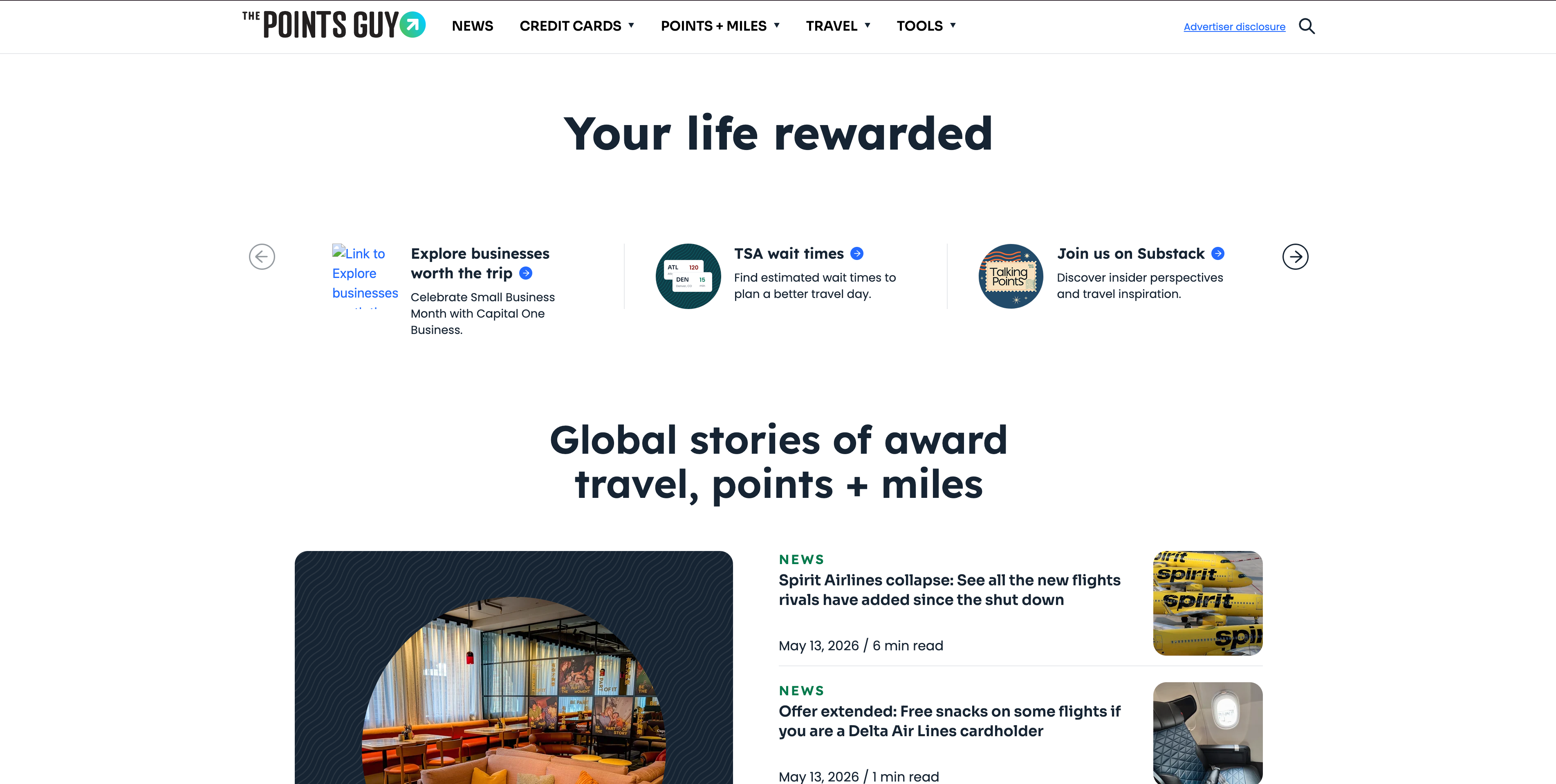
TPG looks like a magazine. Long-form trip reports, expert columns, deep credit-card analyses. The affiliate model is identical to NerdWallet's (credit-card commissions), but the trust mechanism is the editorial voice — named writers with bios, detailed methodology, and reviews that sometimes pan products despite the affiliate relationship.
Trust Stack grade:
- Niche focus: A (travel + premium card rewards)
- Site design: A (editorial magazine affiliate website layout, comparison tables on every review page)
- Content engine: A+ (named expert writers, trip reports, in-depth card analyses)
- Affiliate website monetization: A (affiliate + sponsored content + subscriptions)
- Disclosure: A+ ("Editorial integrity" disclosure on every card review page)
What to steal: Named experts beat anonymous content every time in 2026. Google's E-E-A-T update specifically rewards content with author bios, credentials, and consistent expertise signals. If your site has one writer (you), make sure your About page, author bio, and LinkedIn link all reinforce the same authority story.
Show Image
5 Mistakes That Quietly Kill Affiliate Marketing for Beginners in 2026
You can copy every layout from the best affiliate marketing websites above and still flatline if you make any of these. Affiliate marketing for beginners lives or dies on whether these five errors get caught in the first 90 days — I see at least three of them on 9 out of 10 starter sites I audit.
- Hiding the FTC affiliate disclosure. Per the FTC Endorsement Guides, an FTC affiliate disclosure must be clear, conspicuous, and require no scrolling. A footer-only "Affiliate disclosure" link doesn't cut it — failures can result in fines of up to $46,517 per violation under the FTC Act. Put it above the affiliate links in every post.
- Promoting products you haven't used. Per Shopify's 2026 analysis, this is the single most common reason successful affiliate websites lose reader trust — readers can detect generic specs-copied-from-the-product-page content within seconds. Use the product. Photograph yourself using it. Write what surprised you.
- Targeting traffic instead of buyers. Ranking for "what is a kettlebell" sends informational traffic that almost never converts. Ranking for "best 24 lb kettlebell for home gym" sends commercial-intent traffic. Niche down to bottom-of-funnel comparison keywords before chasing volume.
- Single-affiliate dependence. If your entire income comes from one Amazon Associates account, a single commission-rate change (it's happened multiple times in the last five years) can wipe out 40% of your revenue overnight. Diversify across multiple affiliate programs — Amazon, CJ Affiliate, Impact, ShareASale, and direct brand partnerships.
- Copying free affiliate website templates without changing the structure. Generic affiliate website templates all share the same hero block, the same "10 best" listicle layout, and the same sidebar — which is exactly why Google increasingly suppresses sites built on them. Use a template as a starting point only; differentiate your affiliate website structure with original comparison logic, real testing photography, and a unique methodology page.
How to Build an Affiliate Marketing Website in Minutes with Wegic
Here's the part most affiliate guides skip: even if you understand the Trust Stack perfectly, implementing it traditionally takes weeks — picking hosting, wrestling with WordPress themes, downloading affiliate website templates that all look the same, installing 12 plugins, manually building comparison-table modules. That's exactly what Wegic's conversational AI website builder is designed to compress into about 10 minutes — a faster, more flexible path for anyone learning how to build an affiliate marketing website in 2026.
Phase 1: Brief Kimmy with Your Niche
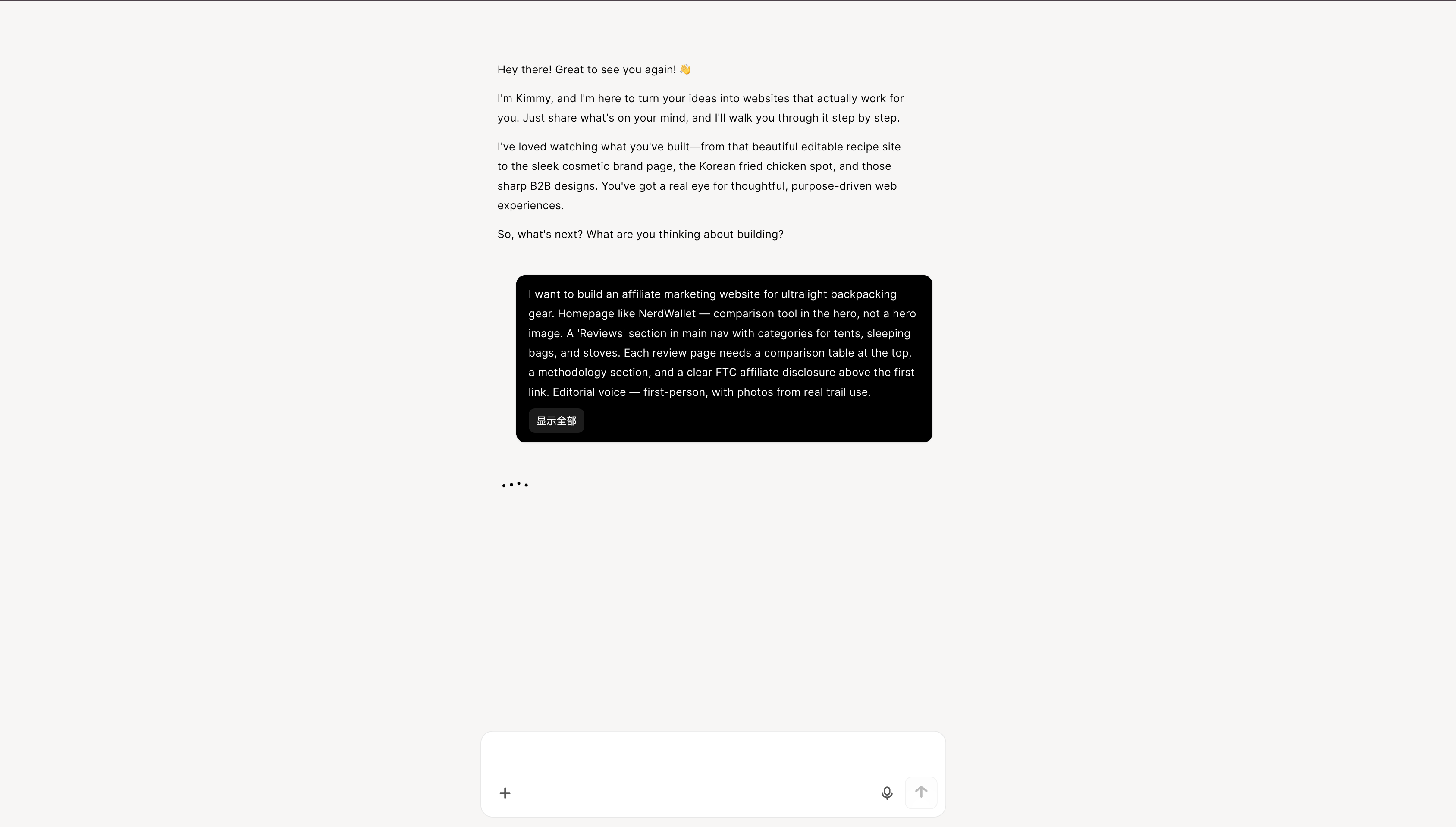
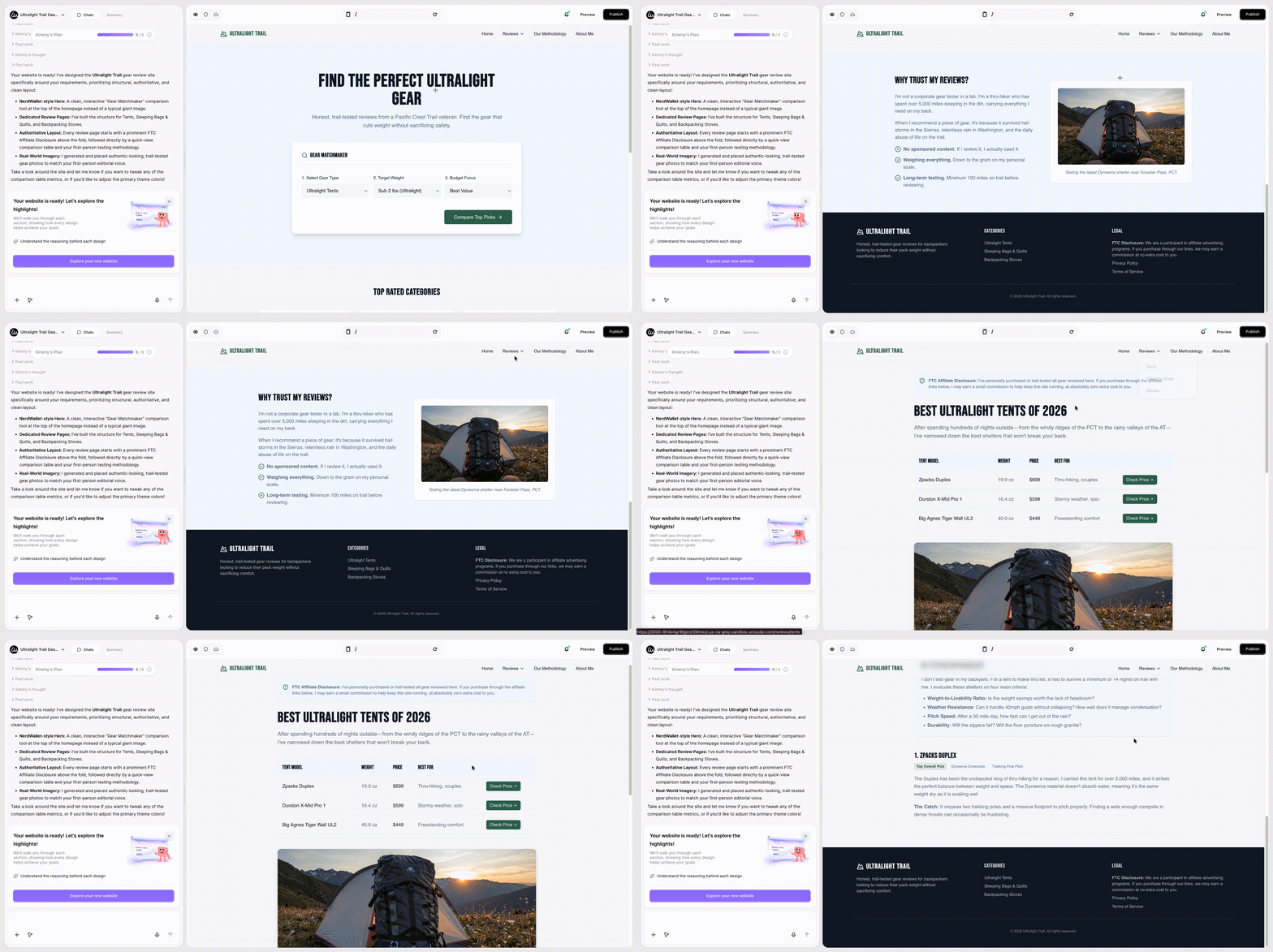
Open Wegic and chat with Kimmy, your AI project manager. Skip the template gallery entirely and describe the affiliate site you actually want, mapped to the Trust Stack:
"I want to build an affiliate marketing website for ultralight backpacking gear. Homepage like NerdWallet — comparison tool in the hero, not a hero image. A 'Reviews' section in main nav with categories for tents, sleeping bags, and stoves. Each review page needs a comparison table at the top, a methodology section, and a clear FTC affiliate disclosure above the first link. Editorial voice — first-person, with photos from real trail use."
Phase 2: AI Assembly in Under 60 Seconds
Wegic's GPT-powered engine reads your brief and generates a fully responsive multi-page affiliate marketing website design from scratch — not a rehash of generic affiliate website templates with your text dropped in. The AI handles visual hierarchy, mobile breakpoints, Core Web Vitals optimization, and on-page SEO defaults automatically.
In the same minute, you also get:
- Auto-generated category structure (Reviews / Guides / About / Disclosure)
- An FTC affiliate disclosure block you can drop above any review
- Pre-built comparison-table sections you can reuse across reviews
- Author bio and methodology page templates for E-E-A-T compliance
Phase 3: Conversational Edits — No CSS Required
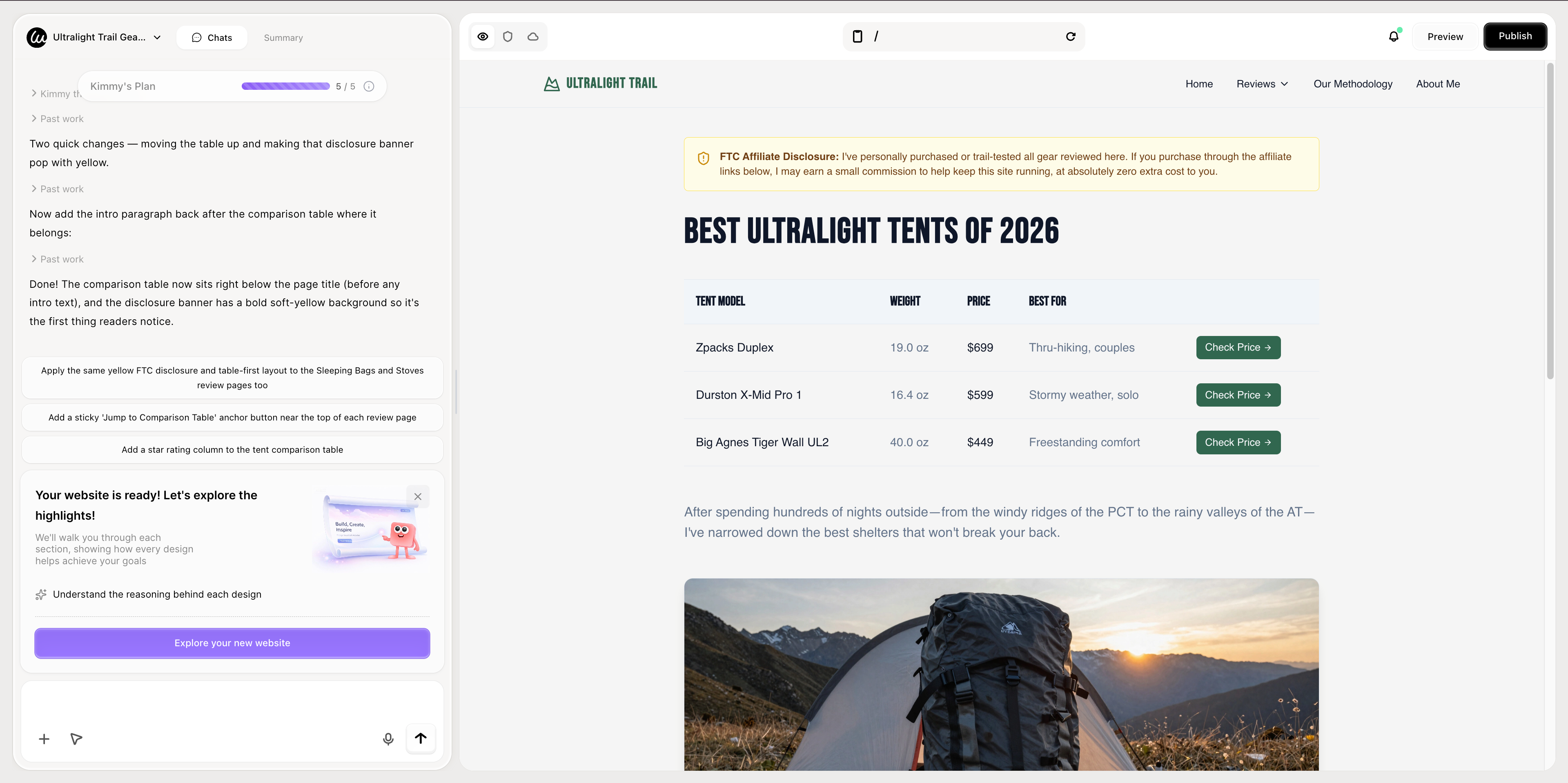
Traditional builders force you into theme editors or CSS panels. Wegic lets you make changes by just describing them:
"Move the comparison table above the introduction on the tent reviews. Make the affiliate disclosure block use a soft yellow background so it's impossible to miss."
Wegic proposes 2–3 design options with reasoning before applying changes, so you never accidentally break your mobile layout — a known risk with traditional drag-and-drop tools. The Wegic features page covers Comment Mode and edit-with-sketch, which let you point at any section and request changes without describing it in words.
Phase 4: One-Click Launch — Hosting, Domain, Sitemap Included
Hit Publish. Wegic ships hosting, a custom domain option, an auto-generated
sitemap.xml, SSL, and clean SEO metadata out of the box — so your affiliate site is live, indexable, and Core Web Vitals–optimized in minutes, not weeks.For more on optimizing the foundation, our topic page on the best AI blog website builder walks through SEO defaults and blogging architecture, both of which apply directly to affiliate sites.
Conclusion: The Trust Stack Is the Only Pattern Worth Copying
The seven affiliate marketing website examples above range from a one-person gardening Amazon affiliate website to a $687M public-company finance site, from a quirky curation page to a magazine-grade travel publication. They look nothing alike. But every one of these successful affiliate websites executes the same five-layer Trust Stack with discipline — and every failing affiliate site I audit is missing at least two layers.
Most projects in affiliate marketing for beginners stall because they obsess over surface decisions (theme color, font pairing, which affiliate website templates to start from) while neglecting the layers that actually drive commissions: clarity of niche, trust signals, affiliate website monetization mix, and visible expertise. Wirecutter doesn't earn nine figures because of its color palette. It earns because every review answers the unstated question: can I trust this recommendation?
The fix isn't more design work. It's more decision-making about who your site is for, what they want to buy, and how you'll prove you're worth believing. Once those decisions are made, the execution is a 10-minute conversation with Wegic — not a four-week WordPress setup.
FAQs
What is an affiliate marketing website?
An affiliate marketing website is a site monetized primarily through commissions on referred sales — when a reader clicks a tracked affiliate link and completes a purchase, the site owner earns a percentage of the sale. Most affiliate marketing site examples combine product reviews, comparison guides, and how-to tutorials to drive search traffic and embed affiliate links naturally. The format ranges from large editorial publications like Wirecutter to single-person niche affiliate website projects, but the monetization mechanism is the same.
How much do the best affiliate marketing websites actually earn?
It varies wildly by niche and experience. According to Authority Hacker's State of Affiliate Marketing survey, the average affiliate site receives ~56,673 monthly visitors, and roughly 35% of active affiliates generate at least $20,000/year. The top 15% earn between $80,000 and $1M annually, and the top 1% exceed $1M. Niche choice is the biggest variable: among the highest-paying affiliate marketing niches, Education averages $15,551/month, Tech $12,475/month, and Health & Wellness $8,038/month, while general-interest sites often earn under $500/month even at decent traffic.
Do I need an FTC affiliate disclosure?
Yes — and it's not optional. The Federal Trade Commission requires that any "material connection" between you and a brand you promote be disclosed in plain language, placed where the endorsement appears, and visible without scrolling. The FTC's Endorsement Guides accept short FTC affiliate disclosure statements like "I earn commissions on purchases through links in this post" placed at the top of the article. Footer-only disclosures or links to a separate disclosure page don't meet the requirement on their own. Violations can result in fines of up to $46,517 per occurrence under the FTC Act.
What are the best affiliate marketing niches in 2026?
The most profitable affiliate marketing niches by average monthly income in 2026 are Education ($15,551), Tech ($12,475), Gaming & eSports ($12,475), and Health & Wellness ($8,038). But "profitable" depends on competition too — those niches are also the most saturated. The smartest approach for new sites is to niche down to a sub-segment with active buyer demand and lower keyword competition. "Outdoor gear" is brutal; a focused niche affiliate website targeting "ultralight backpacking gear for solo thru-hikers" is winnable. Check buyer search demand on Google Trends and validate commission rates on affiliate programs like CJ, Impact, ShareASale, or Amazon Associates before committing.
How do I build an affiliate marketing website without WordPress?
Yes — and increasingly, you should. WordPress works but requires hosting setup, theme purchase, 10+ plugins, and ongoing maintenance. In 2026, conversational AI website builders like Wegic answer the how to build an affiliate marketing website question in a single chat: a fully responsive site (with built-in comparison tables, disclosure blocks, and SEO defaults) generated from a brief in under 60 seconds — without templates, plugins, or code. For most affiliate marketing for beginners projects, the time saved on setup is better spent on content and audience-building.
How long does it take to make money with an affiliate website?
For a brand-new site starting from zero domain authority, expect 6–12 months to see meaningful commissions if you publish consistently and target bottom-of-funnel comparison keywords. Affiliate marketing is not passive income at the start — it's an active business that rewards compounding effort. The good news: well-built affiliate content compounds. A review that ranks in month nine will keep earning while you write month ten's content. Affiliate marketers with three or more years of experience earn an average of 9.45× more than beginners, per Authority Hacker's data.
What's the difference between an affiliate website and a regular blog?
A regular blog is monetized primarily through display ads, sponsored posts, or its own product sales — content variety matters more than purchase intent. An affiliate website uses a deliberate affiliate website structure to route buying-intent traffic to affiliate-linked product pages — reviews, comparisons, and "best of" guides dominate the content. The technical setup is similar, but every structural decision (homepage, navigation, internal linking) on an affiliate site should funnel readers toward commission-bearing pages, and the affiliate website monetization mix should layer in email capture and direct partnerships to reduce dependence on any single program.