A Quick Reset: Why Your Church Website Actually Matters
Three plain-language facts before the examples:
- For most first-time visitors, your website is their first encounter with your church — not a Sunday morning, not a friend's invitation, but a search the night before. If that page doesn't answer "what time, what to wear, where do I park, where do kids go," they often pick a different church.
- More than 60% of church website traffic comes from a phone. People look up service times standing in their kitchen on a Saturday night. A site that's hard to read on mobile loses visitors before anyone has said a word to them.
- Your website is your church's de facto front door. A potential visitor will form an impression of your community before they meet anyone. A warm, clear site signals a warm, clear community; a cluttered or broken one signals the opposite — fairly or not.
Every example below is selected because it solves at least one of those three jobs in a way that's worth studying — across very different traditions.
4 Pattern Categories — Pick the One That Matches Your Church
Pattern | Best for | Example churches | |
1 | Heritage cathedral (visitor + worshipper) | Historic landmarks, cathedrals, abbeys | Notre-Dame, Westminster Abbey, Trinity Wall Street |
2 | Catholic / liturgical (sacramental calendar) | Catholic parishes, Anglican high churches | St. Patrick's NYC, Brompton Oratory, Westminster Cathedral |
3 | Urban plant + multi-generational | Church plants, university-area churches, classic city congregations | HTB Brompton, All Souls Langham Place, Redeemer NYC |
4 | Global / multilingual congregation | Large international churches, immigrant congregations, multi-ethnic urban churches | Yoido Full Gospel, Brooklyn Tabernacle, City Harvest |
The 12 church website examples below are organized into these four groups. Pick the row that's closest to your church, then steal the moves that fit.
Pattern 1: Heritage Cathedrals — When Your Website Has to Serve Worshippers and Tourists Equally
A cathedral website has a problem most parish sites don't: it has to serve two completely different audiences who arrive with completely different intents. A pilgrim who wants Mass times needs a different page than a tourist who wants a self-guided audio tour, and both need to find what they're looking for in under 10 seconds. The three cathedral website examples below solve this duality especially well.
1. Notre-Dame de Paris — Rebuilt Site for a Rebuilt Cathedral
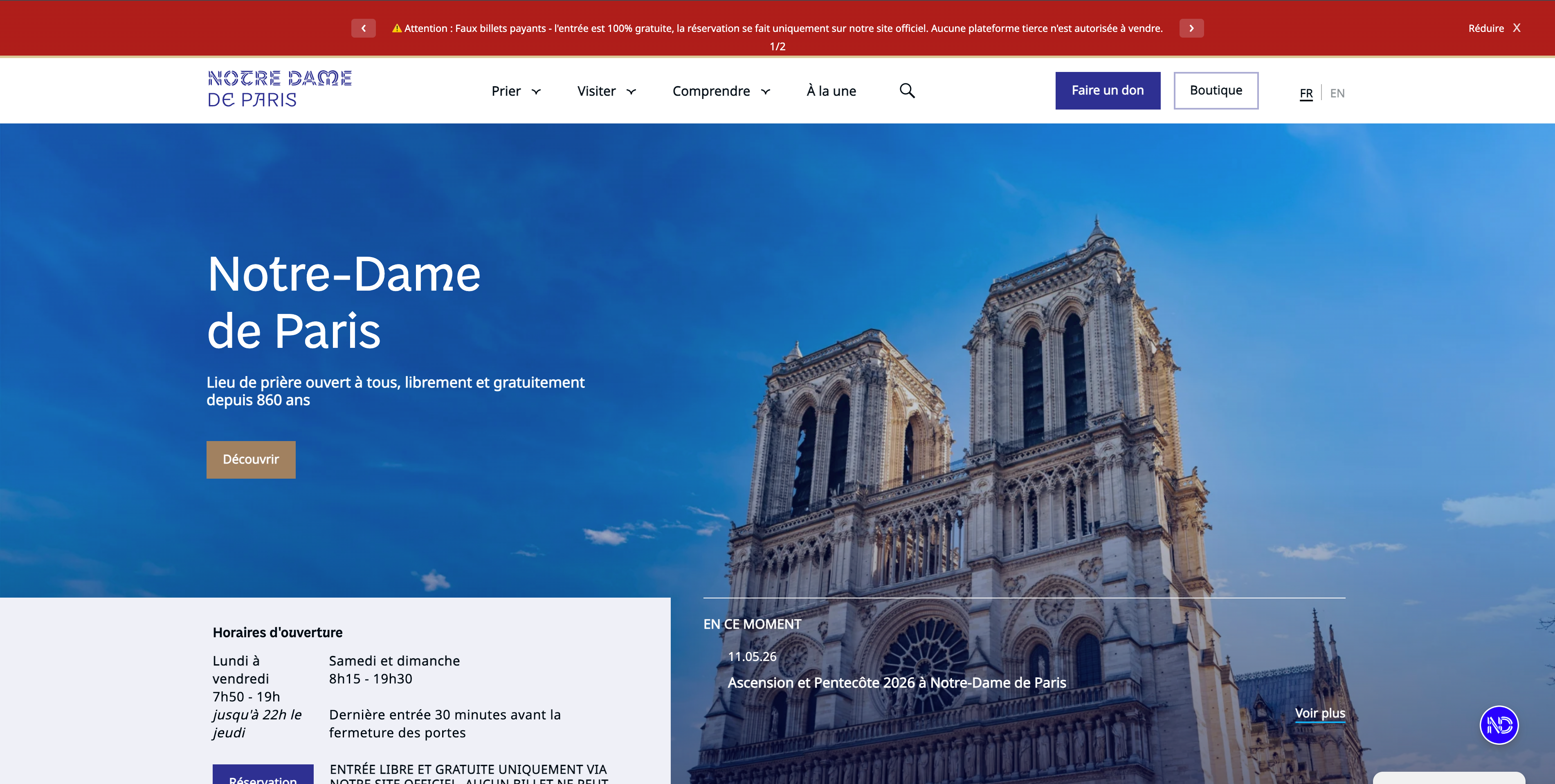
Pattern: Reservation-first heritage site balancing free worship access with timed visitor flow
Notre-Dame's official website was rebuilt for the cathedral's December 2024 reopening after the 2019 fire. The challenge was unique: the cathedral receives 11+ million visitors a year (more than the Louvre), but it's also still an active Catholic cathedral with daily Mass, weddings, and the seat of the Archbishop of Paris. The new site handles both. A free online reservation system lets visitors book a 30-minute entry window, but Mass attendees can still enter freely without booking. Visit information and liturgical schedules sit side by side on the homepage, with neither pushing the other into a secondary role.
Three things to steal:
- A "free reservation" pattern beats "buy tickets" for spiritual sites. Notre-Dame charges nothing for entry — but the timed reservation still serves the church by managing crowding. Many cathedrals and large parishes can borrow this model to manage capacity at peak services without monetizing the door.
- Worshippers vs visitors as two equal-weight CTAs. The homepage gives roughly equal prominence to "Plan Your Visit" and "Mass & Worship Times." Many cathedral sites bury the worship calendar under "About" or "Community." Treat liturgical schedule as a first-class destination.
- A companion mobile app for self-guided exploration. Notre-Dame's "Compagnon de Visite" app delivers history, art commentary, and audio in multiple languages — replacing a paper guide that would have to be redesigned in 8 languages. For any heritage site, a tiny PWA (progressive web app) is now cheaper to ship than printed guides.
2. Westminster Abbey — Royal Ceremonies, Daily Evensong, and a Tourist Map
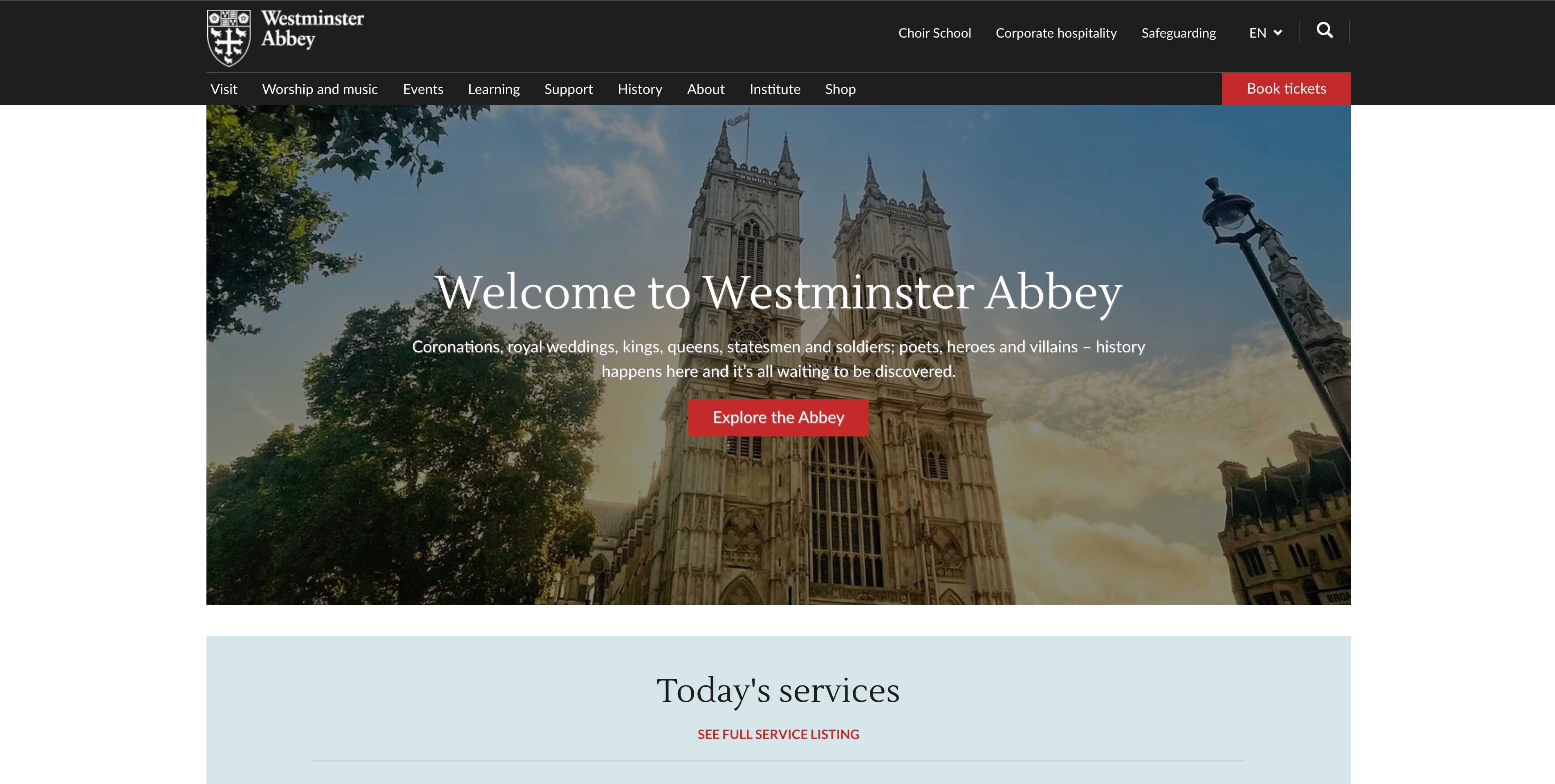
Pattern: Three-audience site (worshippers, tourists, scholars) with clear visual lanes
Westminster Abbey hosts coronations every few decades, royal weddings every few years, daily Evensong every single afternoon, and 1.5 million tourists every year. The website handles these audiences with what's effectively a three-lane top navigation: Visit (tourist track), Worship (services and clergy track), and Learn (history, archives, music). The Abbey's online shop and ticketing live under Visit. The chapter office and choir live under Worship. The same homepage works for a tourist booking a tour and a Londoner attending Evensong tonight.
Three things to steal:
- Three clear audience lanes outperform one cluttered "Resources" mega menu. If your church serves multiple audiences (members / visitors / specific ministries), make the lanes structural — not buried in a hamburger.
- Daily live services deserve their own page — not a calendar entry. Westminster Abbey has a dedicated "Today at the Abbey" page that updates daily with the day's service schedule, who's preaching, and which choir is singing. This is worth copying for any church with weekday services.
- The shop should look like an extension of the church, not Etsy. Westminster Abbey's online shop uses the same typography and color palette as the rest of the site. A bolt-on store with stock photography breaks brand. If you sell anything (books, recordings, merch), design it as part of the church.
3. Trinity Church Wall Street — A Historic Church in the Heart of Modern Finance
Pattern: Active urban Episcopal parish serving worshippers, neighbors, and 1.5 million annual visitors
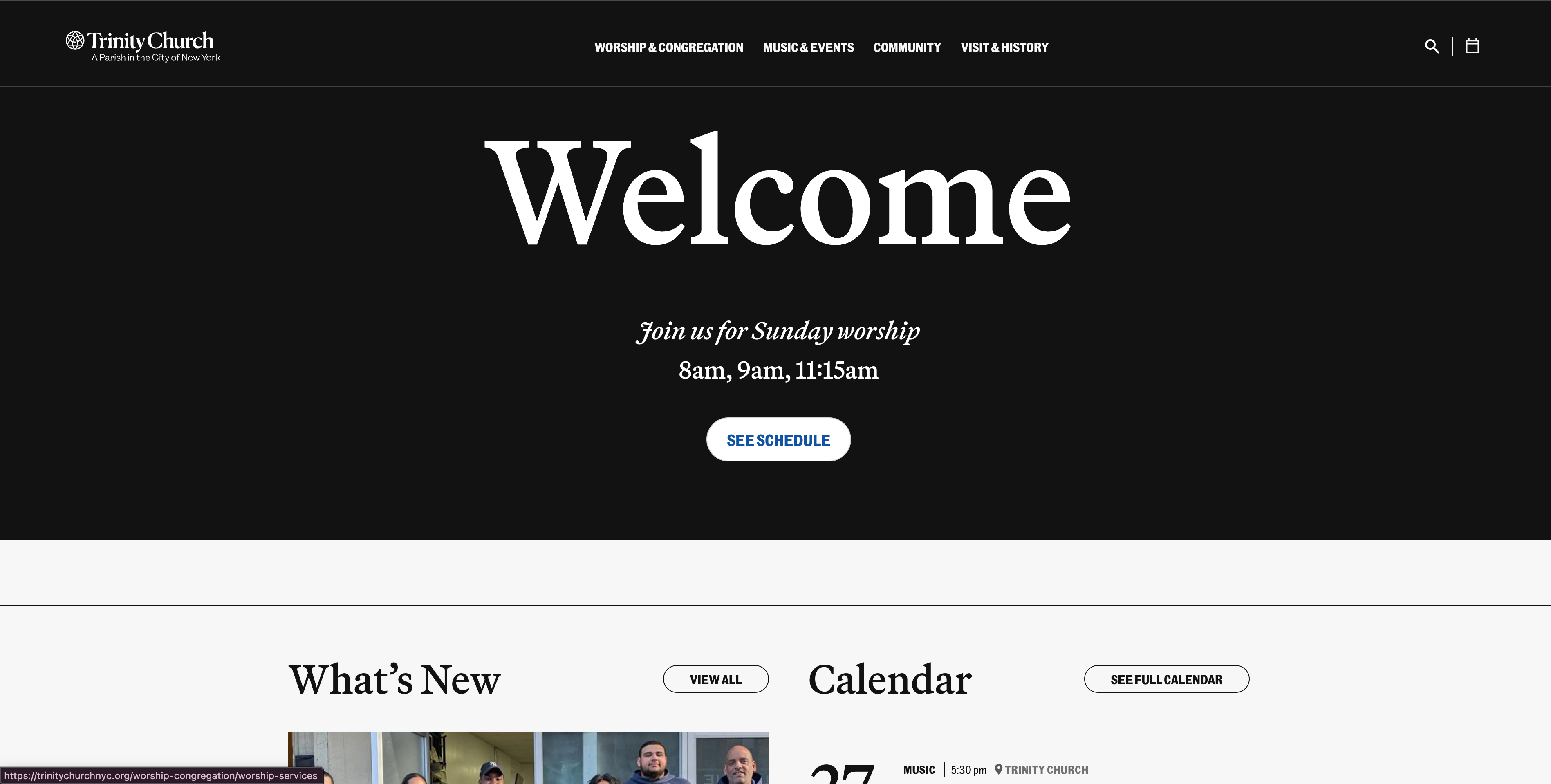
Trinity Church sits at the head of Wall Street, two blocks from the World Trade Center site. It's been an active Episcopal parish since 1697, and its website navigates the tension between being a working church, a 9/11 memorial site, a free midweek concert venue (Bach at One), and a major philanthropic foundation. The homepage uses an editorial layout — feature card, secondary cards, calendar strip — that reads more like a magazine than a church site. This works because Trinity genuinely is producing content (sermons, concerts, theological lectures, racial justice initiatives) at the volume of a media organization.
Three things to steal:
- If your church produces content, design like a media site. Most church websites are brochures with a "Sermons" page tacked on. Trinity treats sermons, concerts, and lectures as a single editorial stream and surfaces them on the homepage like a publication's lead stories.
- Calendar previews on the homepage, not a separate page. Trinity surfaces the next 3–4 events directly on the homepage with date, time, and a one-line description. People come for "what's happening this week," and that should be visible immediately.
- Memorial / sacred ground sites need a quiet, separate page. Trinity's churchyard (where Alexander Hamilton is buried) has its own page with a dignified, restrained design — no animations, no CTAs. Sacred or memorial spaces should feel sacred. Don't put a sign-up form next to a grave.
Pattern 2: Catholic & Liturgical Churches — When the Sacramental Calendar IS the Site
A Catholic church website has design needs almost no list of evangelical megachurches addresses. Mass times in multiple languages and rites. Confession schedules. Baptism preparation pathways. RCIA (Rite of Christian Initiation for Adults). Wedding policies. Funeral arrangements. Holy day rotations. The site's job is less "convert visitors to attendees" and more "serve a sacramental community that already exists" — while welcoming inquirers respectfully. The three churches below do this with notable craft.
4. St. Patrick's Cathedral, New York City — Mass Schedule as the Homepage Hero
Pattern: Catholic cathedral homepage with Mass times as primary content, not buried under About
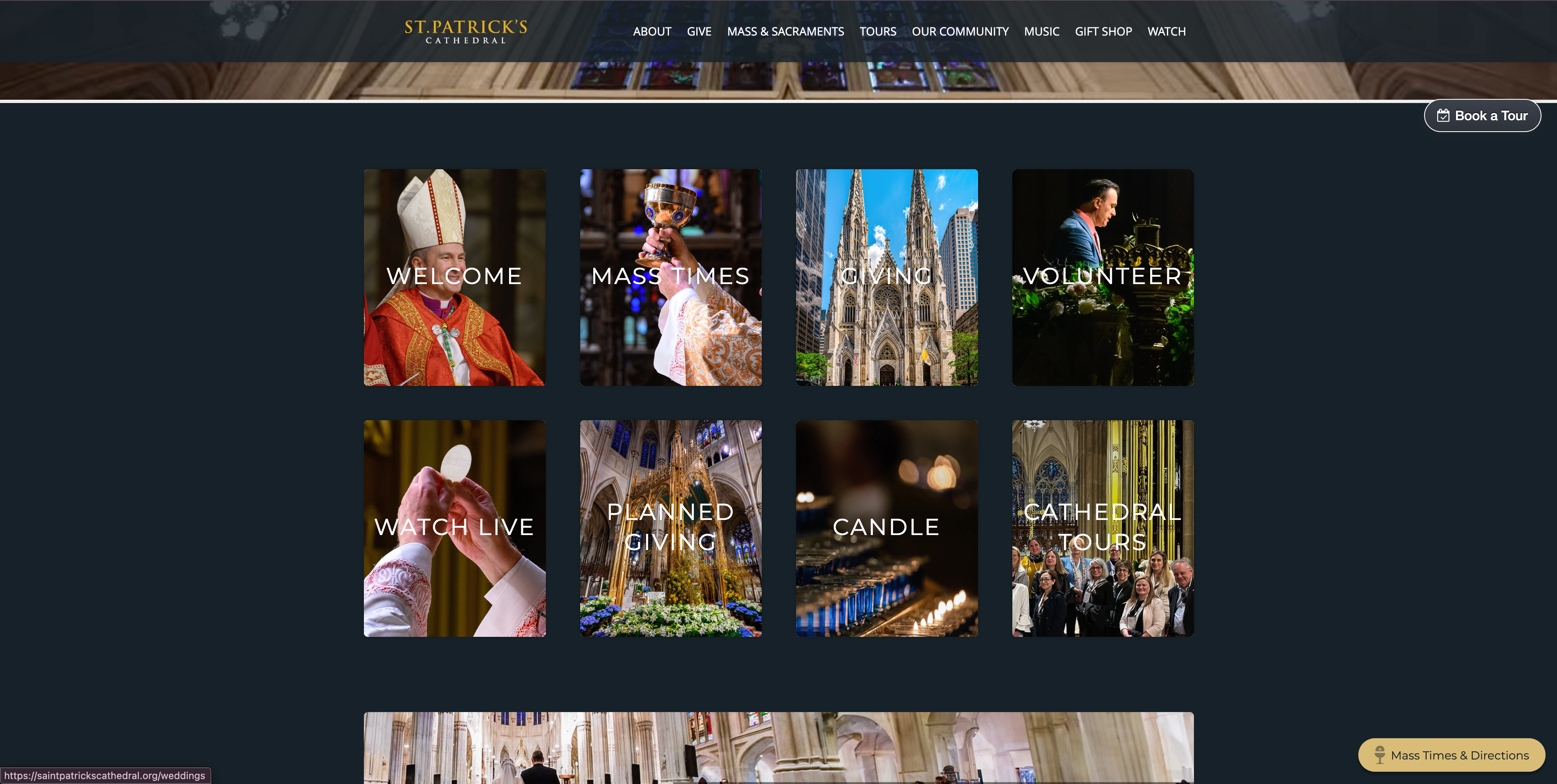
St. Patrick's Cathedral on Fifth Avenue is the seat of the Archbishop of New York and one of the most recognized Catholic landmarks in the United States. Its website does the simplest, most important thing right: the Mass schedule is the first thing you see below the hero. Daily Mass times, Sunday Mass times, Spanish Mass, confession hours — all laid out clearly without forcing the user to navigate. The homepage doesn't try to "convert" the visitor with a Plan Your Visit CTA. It serves them.
Three things to steal:
- Service times above the fold, no exceptions. Whatever else is on your homepage, the schedule of when worship happens should be visible without scrolling. For Catholic and liturgical churches, this means Mass / Divine Liturgy / Evensong / Confession times all in one block, not scattered.
- List languages clearly next to service times. St. Patrick's marks Spanish-language Masses inline (5pm Spanish Mass, etc.) rather than burying them on a separate "Hispanic Ministry" page. If you offer services in multiple languages, treat them as first-class on the schedule.
- Sacramental information needs its own clear hub. Baptism, Marriage, Funeral, Confirmation, Holy Orders — each is a major life event for the visitor. St. Patrick's gives each sacrament a dedicated page with requirements, scheduling, and contact info. This is the Catholic equivalent of an evangelical's "I'm New" path.
5. Brompton Oratory — When Beauty Is the Brief
Pattern: Traditional Catholic parish known for liturgical music and Latin Mass, with a website that matches its aesthetic
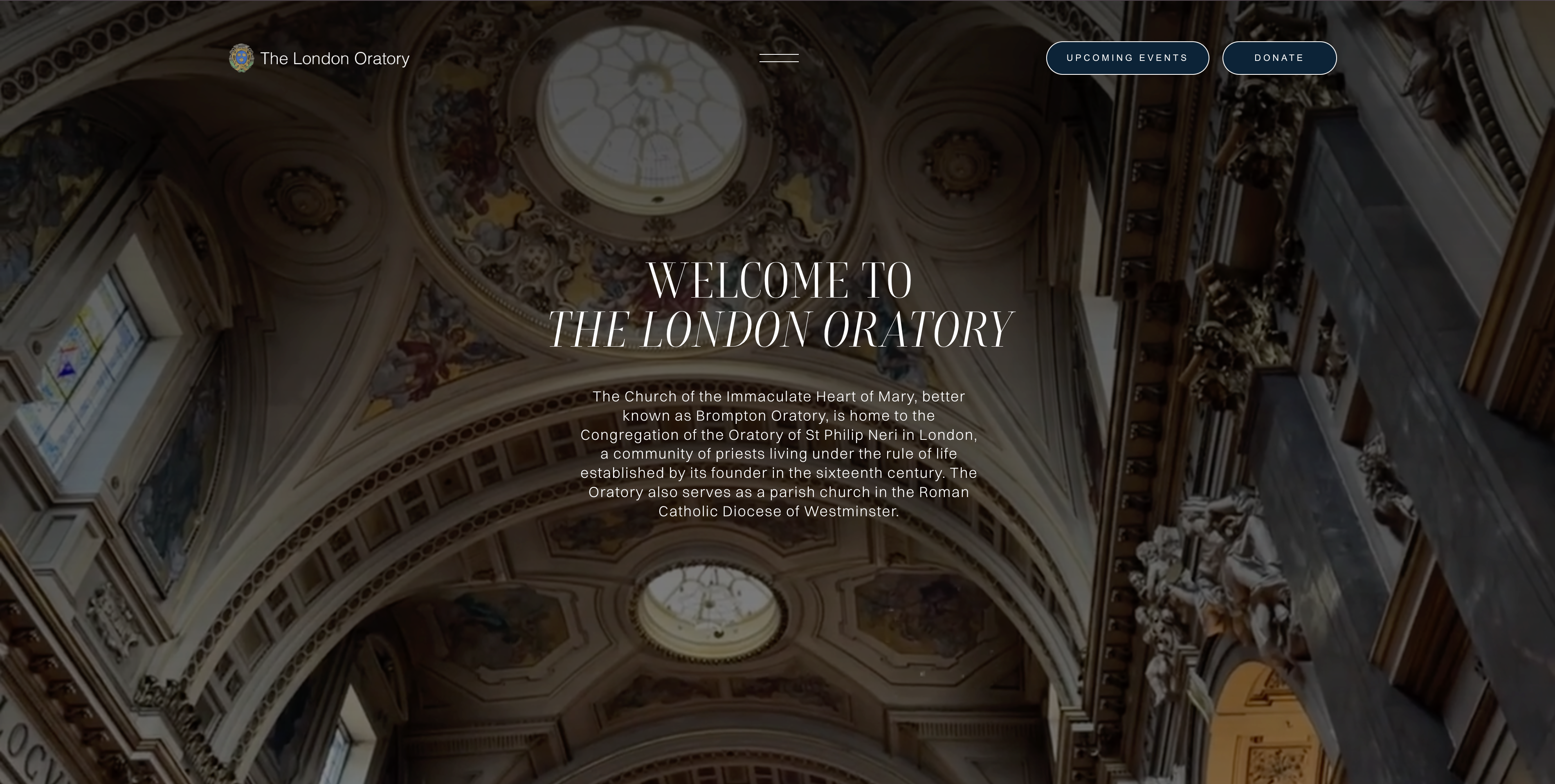
The Brompton Oratory is one of London's most architecturally significant Catholic churches and one of the few in England that regularly celebrates the Traditional Latin Mass. Its website is unusual among parish sites for how clearly it embraces a *specific aesthetic*: serif typography, restrained black-and-white photography, classical music recordings front and center, and a Mass schedule that distinguishes between Ordinary Form, Extraordinary Form (Latin), and feast-day liturgies. The site looks like an extension of the building's 19th-century Baroque interior — and that consistency is the whole point.
Three things to steal:
- Match your design language to your liturgical tradition. A church that worships in Latin shouldn't have a website that looks like a SaaS landing page. Sans-serif geometric typography reads as "modern startup"; serifs and editorial layouts read as "tradition." Pick deliberately.
- Surface your music ministry prominently if it's central to your worship. Brompton Oratory's choir is internationally renowned, and the homepage links directly to recordings, broadcast schedules, and concert details. For any church where music is part of the identity, treat it as a first-class navigation item.
- Distinguish between rites and forms on your Mass schedule. A Mass-goer who wants Latin Mass isn't served by a generic "Sunday Mass 10am" listing. Brompton Oratory marks each service with its form, language, and choir. If you offer variety, surface it.
6. Westminster Cathedral — The Mother Church Done with Restraint
Pattern: Roman Catholic mother church of England & Wales, balancing tourist visits with daily liturgical life
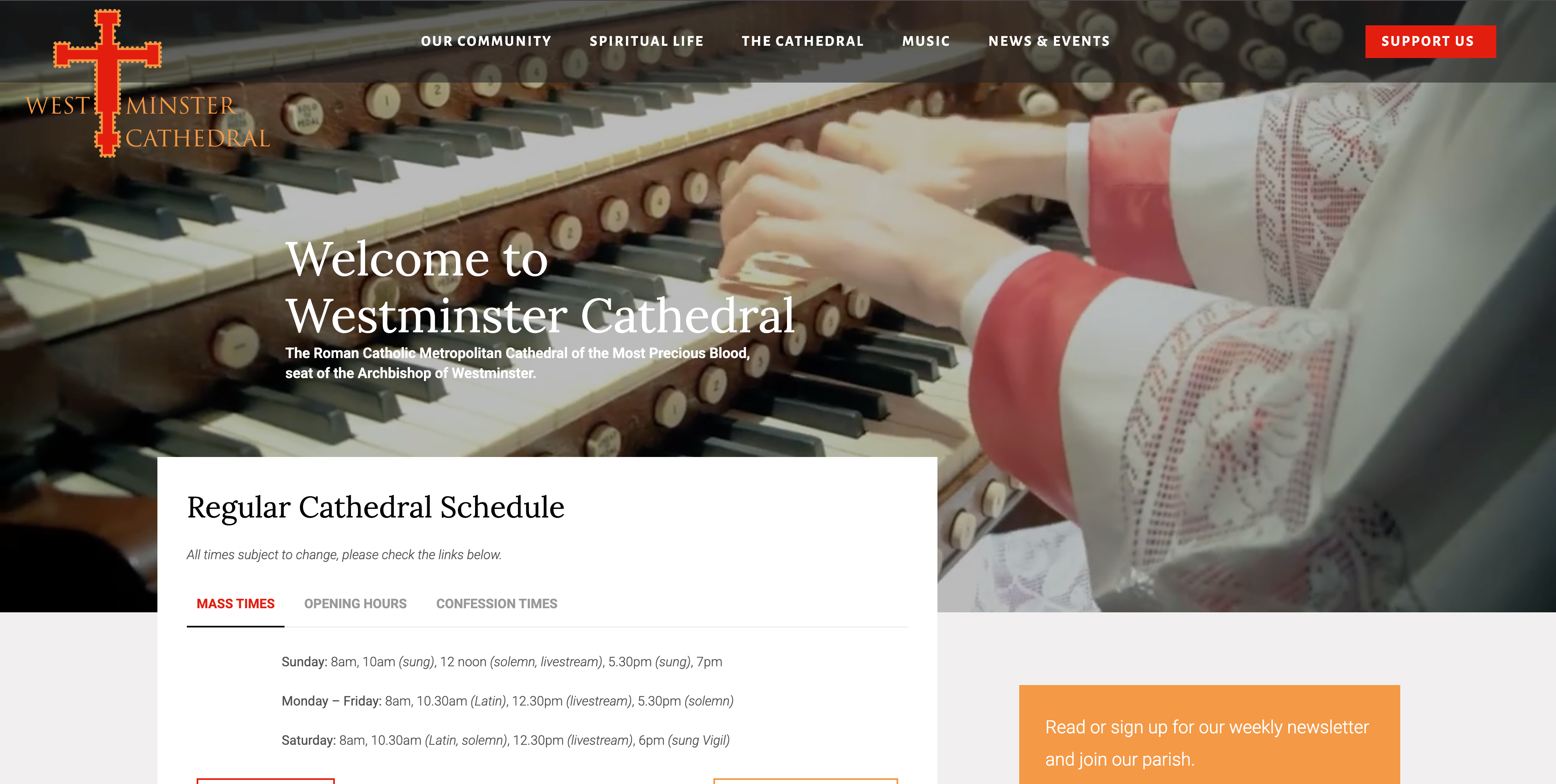
Westminster Cathedral (not to be confused with Westminster Abbey, which is Anglican) is the principal Catholic church in England. Its website handles a similar visitor/worshipper duality to Notre-Dame, but at smaller scale. The design is deliberately understated: a clean header with primary destinations (Services, Music, Visit, History, Cathedral Hall), a calendar of upcoming Masses on the homepage, and a separate, beautiful section for the Cathedral Choir (one of the most famous Catholic choirs in the world).
Three things to steal:
- Restraint reads as authority for established institutions. A 100-year-old cathedral doesn't need to convince anyone of its credibility with bold typography. A clean, restrained design signals confidence. Save the loud design for the church plant trying to be noticed.
- A "Cathedral Hall" or "Venue Hire" page for buildings that double as event spaces. Many historic churches subsidize maintenance through concerts, weddings, and corporate events. Westminster Cathedral has a clear, professional page for this. Don't hide your venue business — many people search for it specifically.
- Live-stream Mass should be a permanent feature, not a pandemic relic. Westminster Cathedral live-streams daily Mass and the major feast-day liturgies. The links live in a permanent header strip. For Catholic and liturgical churches, this is non-negotiable in 2026.
Pattern 3: Urban Church Plants & Multi-Generational Congregations
These are the churches where the "I'm New" path matters most — and where the modern church website patterns from megachurches partly apply but need adaptation. The three churches below are influential in evangelical circles globally, but each takes a noticeably different approach from the standard Hillsong-template aesthetic.
7. Holy Trinity Brompton (HTB) — Birthplace of the Alpha Course
Pattern: Anglican charismatic church in London with global Alpha Course influence and a strong young-professional demographic
HTB is the most influential Anglican church in the English-speaking world for what it produced: the Alpha Course, the global introduction-to-Christianity program. Its website handles the dual identity well — a clear "What's on this Sunday" focus for the London parish, and a separate front door for Alpha (which is its own brand at alpha.org). The HTB homepage is unusually conversational: large photographs of actual people in the congregation, copy written in second person, a "Plan Your Visit" experience that walks you through what to expect on Sunday morning step by step.
Three things to steal:
- A multi-step "What to expect on Sunday" guide reduces first-visit anxiety more than any other single page. HTB's version walks visitors through arrival, the service, kids' check-in, and after-church coffee. For first-time church-goers, this single page is the highest-conversion asset on the site.
- Real congregation photos beat stock photography by orders of magnitude. Every photo on HTB is of HTB. The result is a site that looks like a community, not a brochure. Hire a photographer for one Sunday morning if you don't have a budget for ongoing photography.
- If you run a flagship program, give it its own brand. Alpha is bigger than HTB at this point. Rather than trying to fit Alpha into the HTB site, HTB lets Alpha be its own thing — and links to it from a dedicated section. If your church runs a recovery program, school, or counseling ministry, consider whether it deserves its own brand.
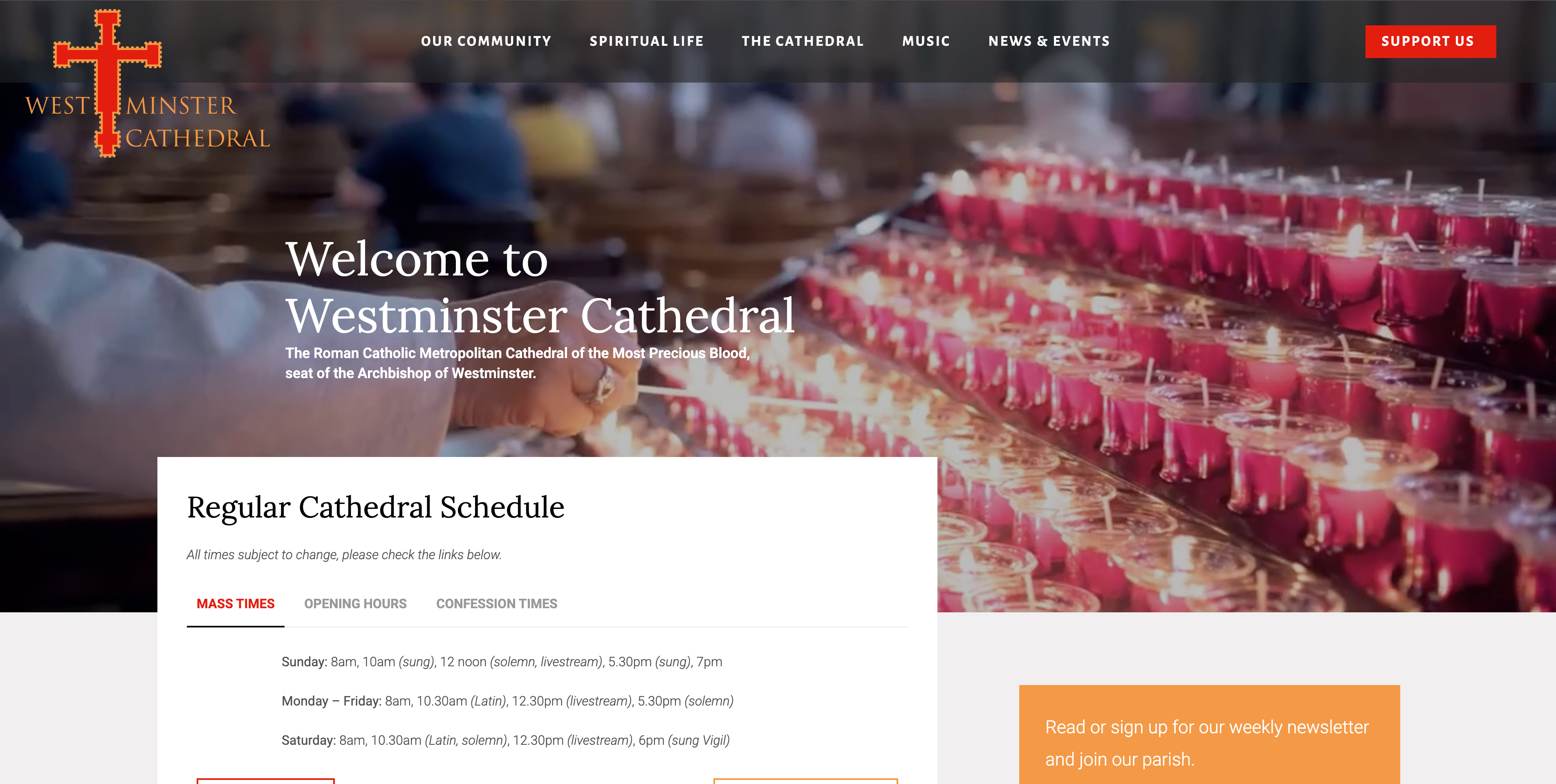
8. All Souls Langham Place — When the Congregation Spans Five Generations
Pattern: Historic Anglican evangelical church in central London with an unusually broad demographic (students through retirees)
All Souls sits across from the BBC's Broadcasting House in central London. It was John Stott's church for 50 years and is one of the most influential evangelical Anglican congregations in the world. The challenge: All Souls' Sunday service includes 21-year-old university students, mid-career professionals, expatriate diplomats, and elderly long-term members in the same room. The website reflects this by being deliberately understated and information-rich — not trying to be cool for the students or stiff for the retirees. Service times, sermon archive, ministries by life stage (Students, 20s-30s, Internationals, Families, Seniors), and theological resources all have equal weight.
Three things to steal:
- Organize ministries by life stage, not by activity name. "Students," "20s-30s," "Families," and "Seniors" works better than "Bible Studies," "Small Groups," and "Fellowship." People find what's relevant to them faster.
- A robust sermon archive with text and audio is worth more than livestream. All Souls' sermon library includes audio, transcripts, scripture references, and series organization. Sermons get found through Google search, which is impossible if you only have video.
- Translate the theological vocabulary for outsiders, but don't dumb it down. All Souls uses words like "evangelical" and "expository preaching" on its site — because their audience either knows what those mean or actively wants to learn. Don't strip jargon that has real meaning; just define it once.
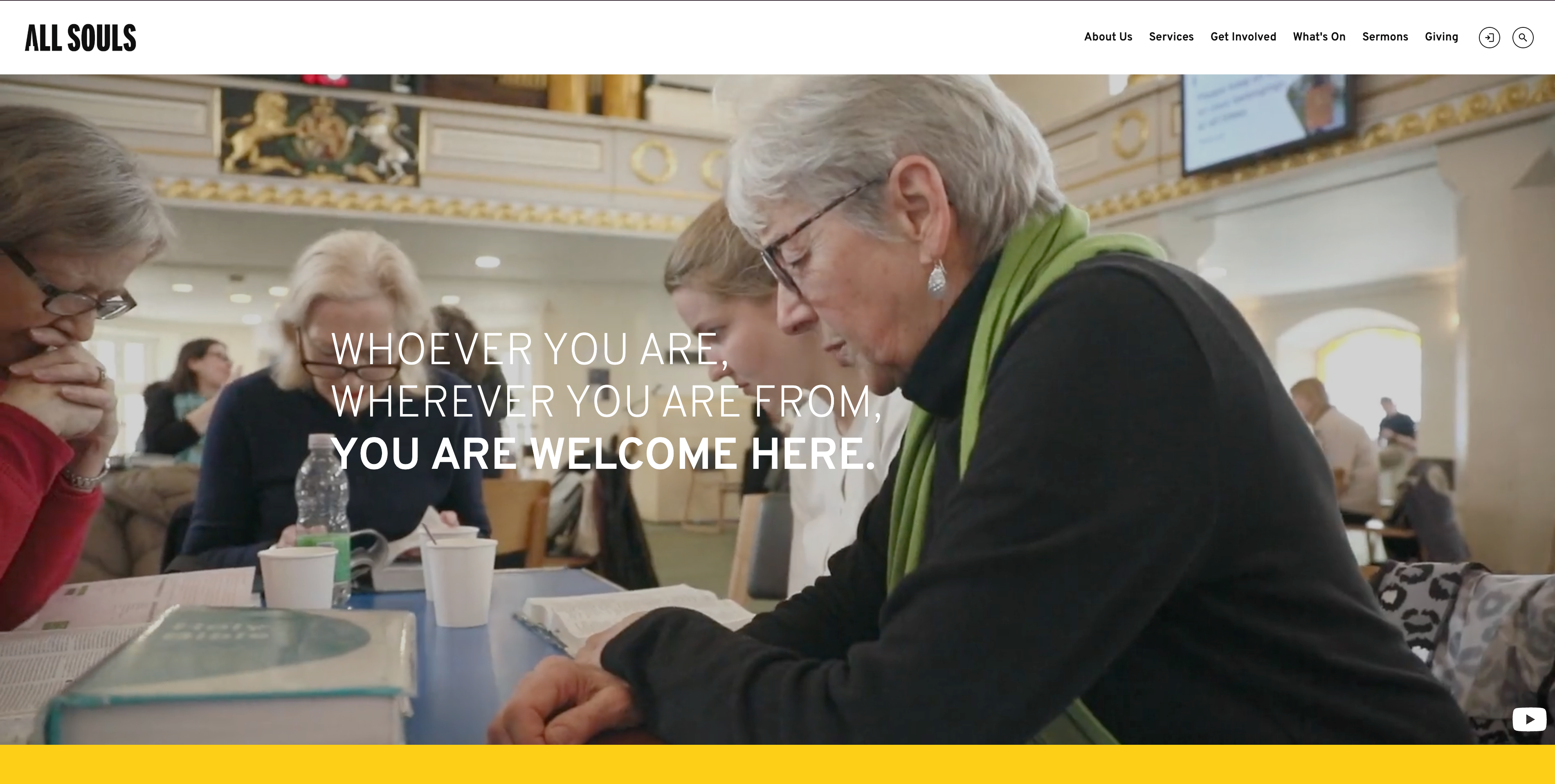
9. Redeemer Churches & Ministries — Tim Keller's Network of NYC Plants
Pattern: Multi-parish Presbyterian network in New York City emphasizing thoughtful urban ministry
Redeemer Presbyterian was Tim Keller's church in Manhattan and grew into a small network of related congregations across NYC after his retirement. The website navigates that complexity well: a single Redeemer.com hub introduces the philosophy of the network and links to the individual congregations (Redeemer East Side, West Side, Downtown, Lincoln Square), each with their own site and pastor but a shared theological identity. The homepage favors thoughtful long-form content (essays, podcasts, resources for urban Christians) over event promotion — which matches Keller's intellectual legacy.
Three things to steal:
- Network sites need a clear hub-and-spoke architecture. If your church has multiple congregations or plants, decide which information lives on the hub and which lives on the spokes. Redeemer puts theology and philosophy on the hub; service times and local ministries on the spokes. This is the right split for multi-site church website networks.
- Long-form resources build authority over time. Redeemer publishes essays, podcasts, and articles that reach people who'd never attend Sunday — and many of them eventually do. A church website with substantial reading material outranks event-only sites in search over the years.
- A "City for the City" or local-mission page builds trust with non-attending neighbors. Redeemer has an explicit page about their commitments to the city of New York — partnerships, justice work, neighborhood ministries. This communicates to potential visitors that the church is for the city, not just in it.
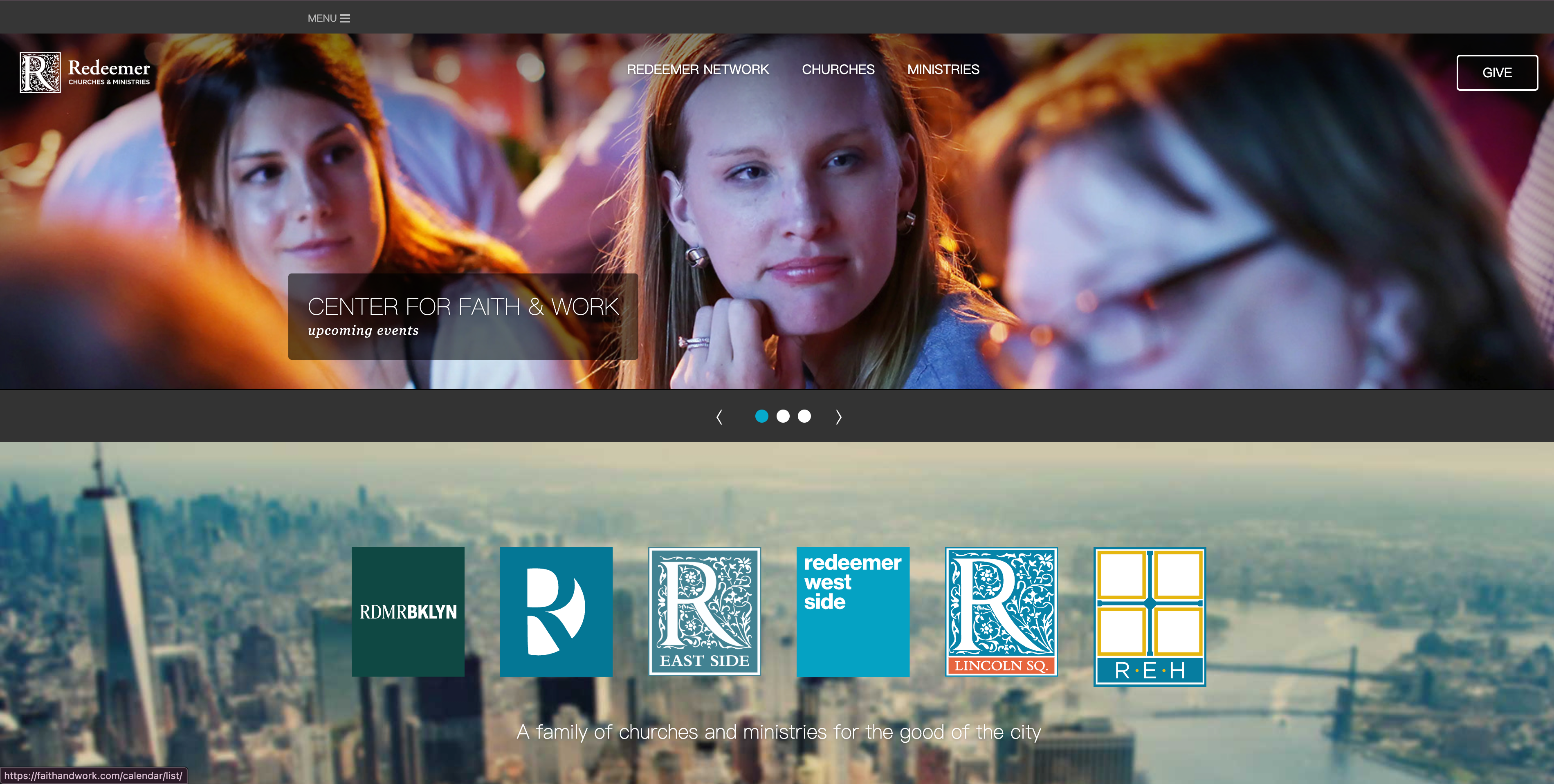
Pattern 4: Global & Multilingual Congregations — When Your Visitors Don't All Speak English
Some churches serve a city in many languages, others serve an immigrant community whose first language isn't English, and a few — like the largest church in the world — serve more than half a million people across continents and need to do it in multiple languages and time zones. These church website examples look very different from American megachurch templates.
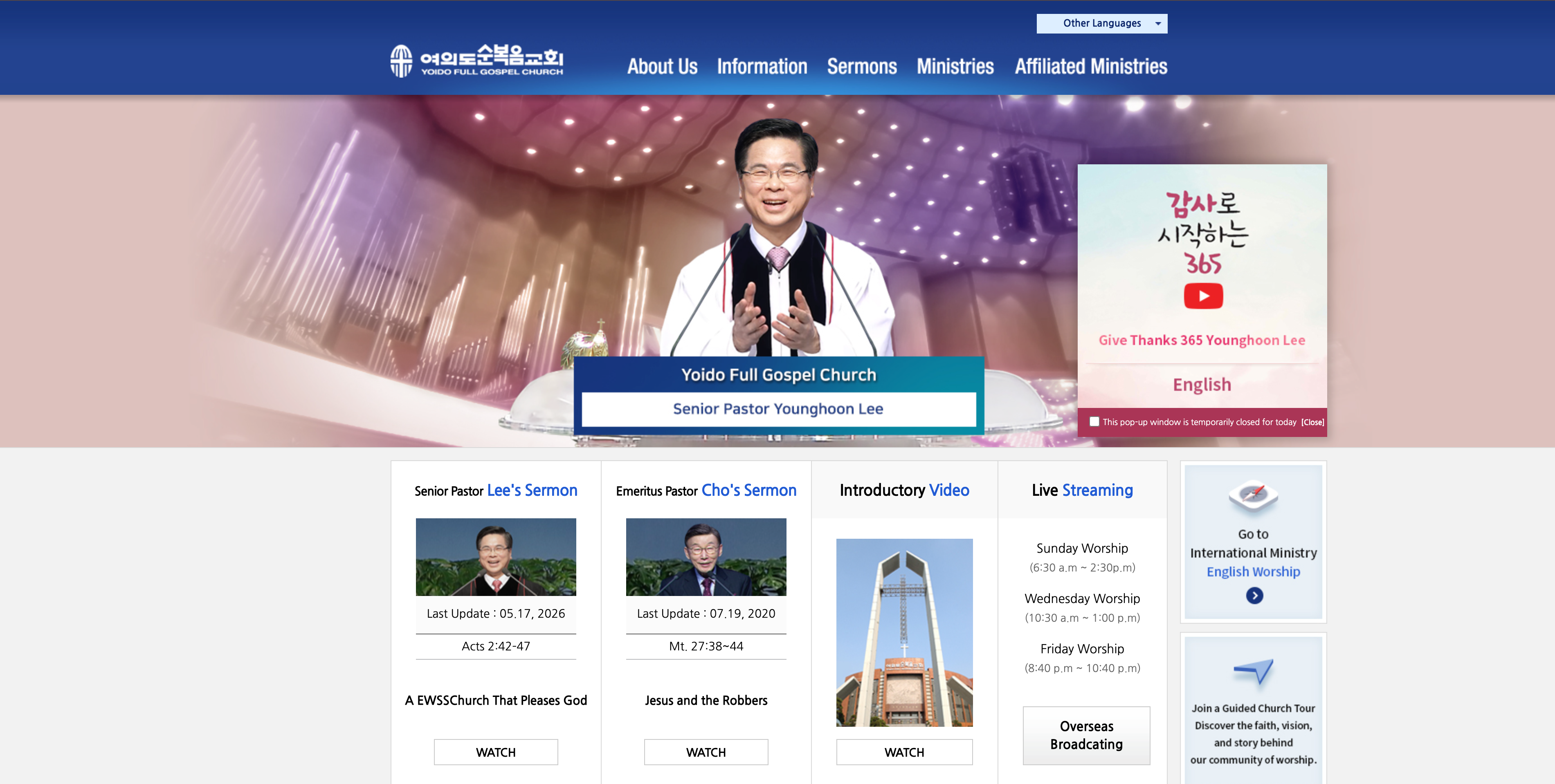
10. Yoido Full Gospel Church — The Largest Congregation on Earth
Pattern: Korean Pentecostal church with 480,000+ members, multi-language website, and multiple weekly services
Yoido Full Gospel Church in Seoul is the largest single congregation in the world. The website is necessarily multilingual — Korean, English, Japanese, Chinese, Spanish, and others — with each language version maintaining its own news, sermon archive, and service times rather than being a thin translation of the Korean site. Multiple services run every Sunday (5am, 7am, 9am, 11:30am, 1:30pm, 4pm, 7pm) to handle the volume. The site treats each language as a first-class experience, not a Google Translate widget.
Three things to steal:
- A real multilingual site is not a translate widget. Each language version should have its own URL structure (
/en/,/es/,/ko/), its own SEO meta tags, and ideally its own content — not just an automated translation. Google ranks language-specific pages separately, and a properly internationalized site earns search traffic in each language. - Multiple service times deserve a dedicated grid layout. When you have 7 services on a Sunday, a list looks overwhelming. Yoido uses a grid that pairs each service time with the worship style, language, and location (the main sanctuary holds ~12,000 people; overflow chapels carry the additional services). For any multi-service church, treat the schedule as a real piece of interface design.
- Time zones matter for global congregations. Yoido's English site shows service times in Korea Standard Time (with UTC offset) — necessary for the international diaspora who join livestreams from elsewhere. If your church streams globally, show times in the streaming user's time zone or make UTC explicit.
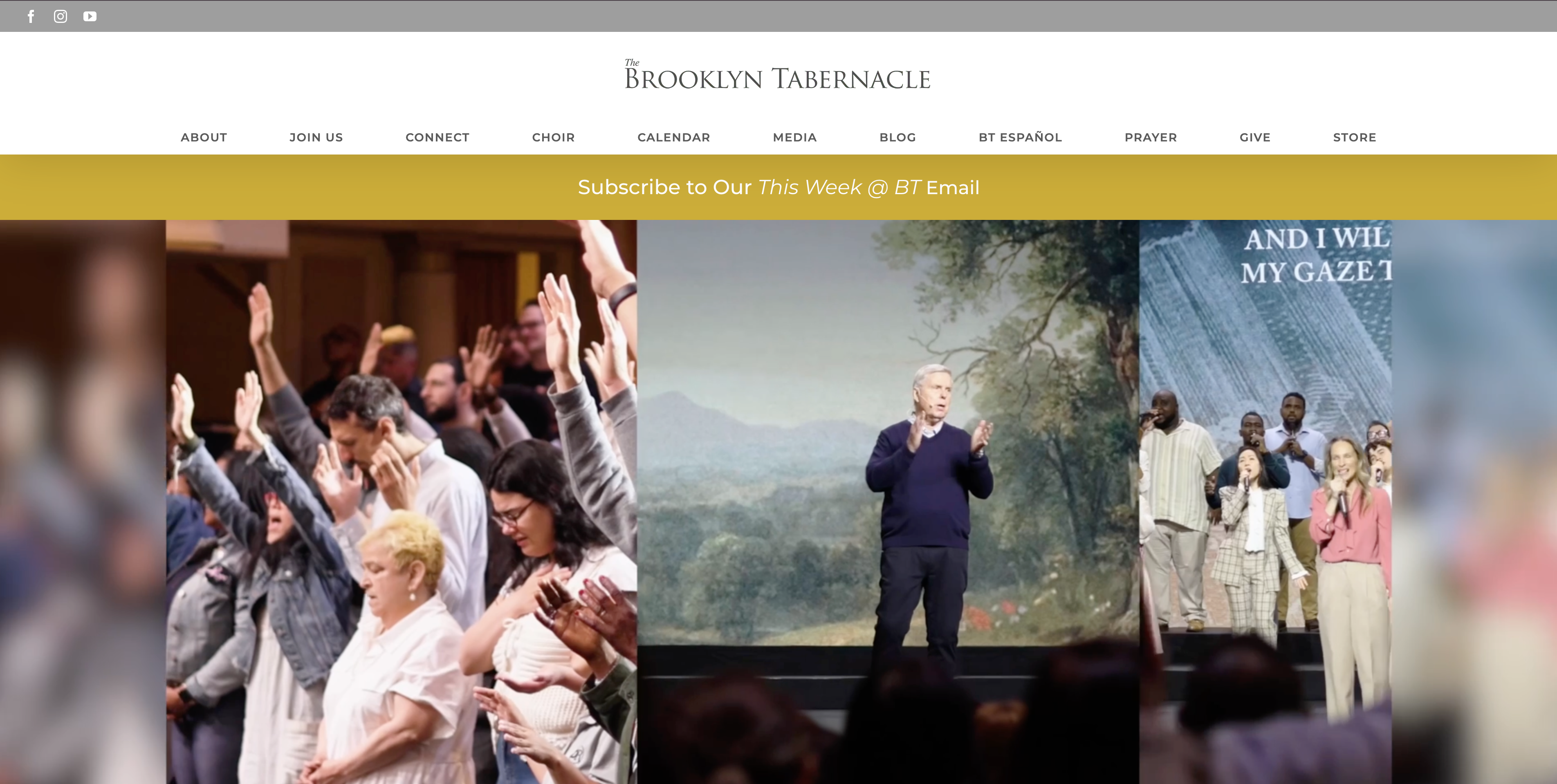
11. Brooklyn Tabernacle — A Multi-Ethnic Church That Looks Multi-Ethnic
Pattern: Independent church in downtown Brooklyn known for its Grammy-winning choir and a demographic that mirrors NYC itself
The Brooklyn Tabernacle's congregation is famously diverse — roughly evenly split across Black, Hispanic, Asian, and white attendees, with services in English and Spanish. The website looks like that congregation. The homepage photography shows the actual congregation, not stock images of a homogeneous group. Spanish-language content lives in parallel to English, not as a smaller version. The church's six-time Grammy-winning choir gets prominent placement because it's a real part of the church's identity, not just a marketing asset.
Three things to steal:
- If your congregation is diverse, your photography must show it. Stock photos of white smiling families on a church website are a tell that the church isn't what it claims to be. Show your actual people. This applies even more strongly to immigrant and multi-ethnic congregations.
- Spanish content (or whatever your second language is) should be a sibling to English, not a child. Don't relegate Spanish to a "Ministerio Hispano" sub-page. Brooklyn Tabernacle gives Spanish content equal prominence in the navigation.
- A flagship ministry (choir, school, recovery program) deserves its own home on the site. Brooklyn Tabernacle's choir has its own section with recordings, choir membership info, and concert schedules. If you have something the wider community knows you for, treat it as a destination, not a footnote.
12. City Harvest Church — Singapore's Global Pentecostal Megachurch
Pattern: Asian Pentecostal multi-site church with major youth ministry and global media presence
City Harvest in Singapore is one of Asia's largest churches, with around 18,000 members across multiple service times and locations. The website handles a distinct Asian megachurch design challenge — high information density without feeling cluttered, multiple ministries (youth, kids, young adults, families) each with active programs, and a strong media production arm. The homepage uses a card-based grid that lets visitors visually scan ministries, events, and content streams in one pass. Service times for both English and Mandarin services are surfaced clearly.
Three things to steal:
- Card-based grids beat long scrolling pages for high-volume churches. When you have 8 active ministries and 3 service times and a sermon every week and 5 upcoming events, a vertical scroll buries half of them. A card grid lets visitors scan everything in one view.
- Show youth and young adult ministry content prominently for any church with that demographic focus. City Harvest's youth ministry has equal visual weight to adult services on the homepage — appropriate for a church with that strategic priority.
- Mandarin / Cantonese / native-language services deserve clear callouts on the schedule. Asian congregations often serve multiple language communities under one roof. Make the language of each service obvious; don't make Mandarin attendees hunt.
The 5 Mistakes That Quietly Cost Your Church Sunday Visits
Across hundreds of church web design audits, these five errors account for the majority of failing church sites:
- Service times buried under "About" or "Contact." The #1 thing a first-time visitor wants is when and where you meet. If it takes more than one click to find this, you're losing visitors. Service times belong on the homepage, above the fold, on every device.
- "I'm new" or "Plan Your Visit" missing entirely. A first-time visitor needs a clear path: where to park, what to wear, where kids go, what the service is like. Many small church website owners assume "everyone in town knows us" — but the visitor on your homepage probably doesn't.
- The mobile site is half the desktop site. Over 60% of church website traffic is mobile, but many churches design for the laptop where they review the site. Test on a phone, not just DevTools. A mobile church website has to be the primary version, not the responsive afterthought.
- Photos that aren't of your actual church. Stock photos of generic worship services, smiling families, or sunset crosses signal that the church doesn't have a story to tell. One Sunday morning with a real photographer beats ten stock photos.
- No way to give online (or a giving page that feels like a transaction). Online giving isn't optional in 2026 — but it also shouldn't be the first or loudest CTA. Make it findable but tasteful. Don't put a "DONATE NOW" button next to your homepage hero.
Modern Church Website Best Practices in 2026
Beyond the mistakes above, six things separate the best church website examples 2026 from the rest:
- Service times in the header, persistently visible. Not buried in a "Visit" page — surfaced everywhere on the site.
- Plan Your Visit as a dedicated multi-step page. Parking, dress code, what to expect, where kids go, who to find when you arrive. Walk visitors through it.
- Sermon library with audio, video, and text. Sermons should be findable on Google. Text transcripts make that possible.
- Online giving that's frictionless but understated. One-click giving via Apple Pay or Google Pay; recurring options surfaced gently; no manipulative urgency.
- Live-streaming as a permanent feature, not a pandemic leftover. Even small churches can stream to Facebook or YouTube. For homebound members, this is genuine ministry.
- An honest, clear "What we believe" page. Vague "We're a community of seekers" copy reads as evasive. State what your church teaches — visitors looking for a doctrinal home appreciate the clarity.
How Wegic Generates Church Websites by Default
Most church website builder platforms make you start with a template that looks like every other church. Wegic doesn't use templates — it generates the site from a conversation about your specific church. Tell Wegic about your tradition, your service times, your ministries, and your community, and the AI generates a site shaped around your actual congregation, not a stock layout.
Wegic is a conversational AI website growth system. Instead of choosing a template's pre-baked layout, you describe your church and Wegic writes the site code from scratch — including the sermon archive, the giving page, the "Plan Your Visit" flow, and the responsive layout.
Phase 1: Brief Your AI
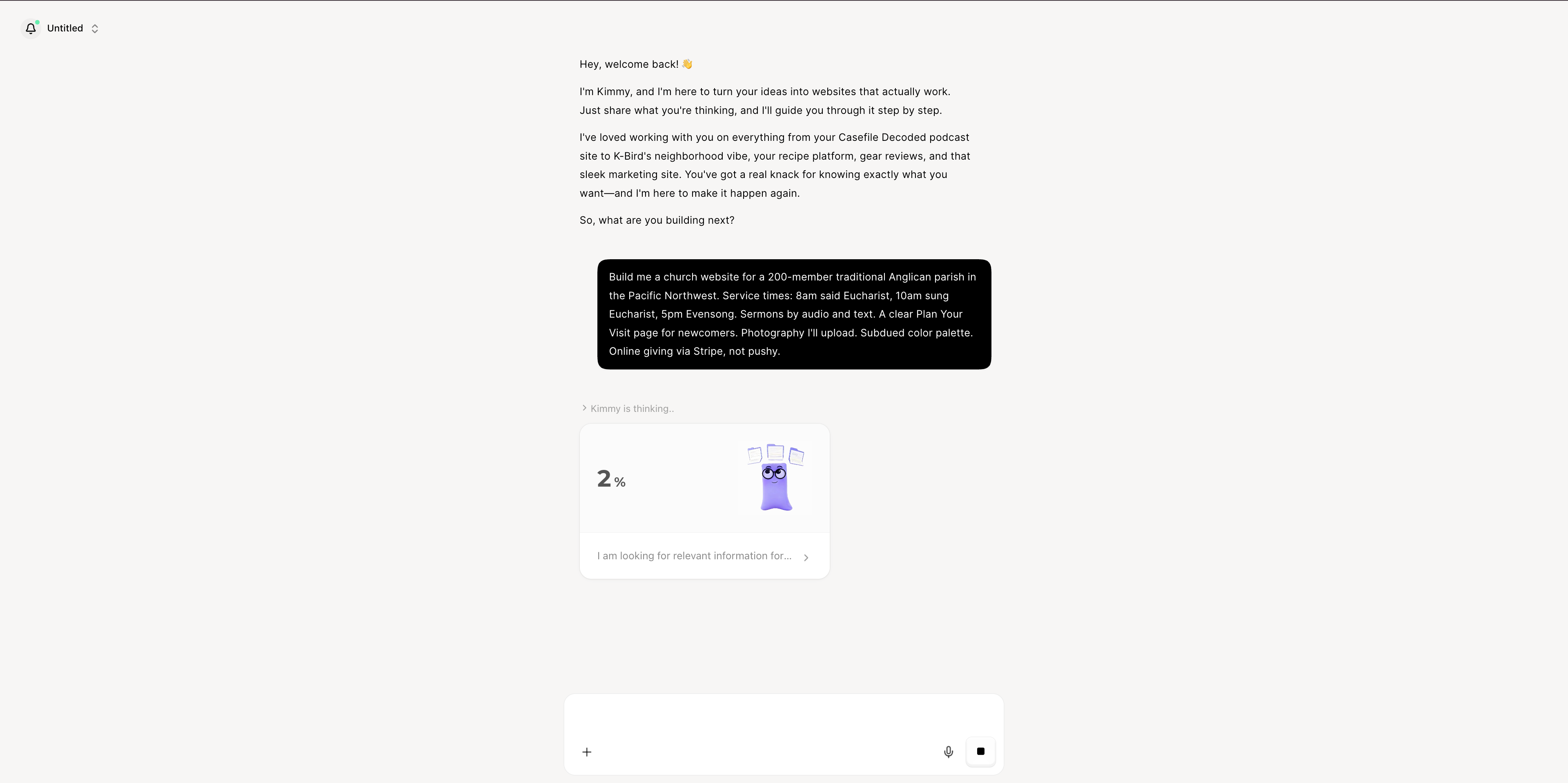
Open Wegic and chat with Kimmy, your AI project manager:
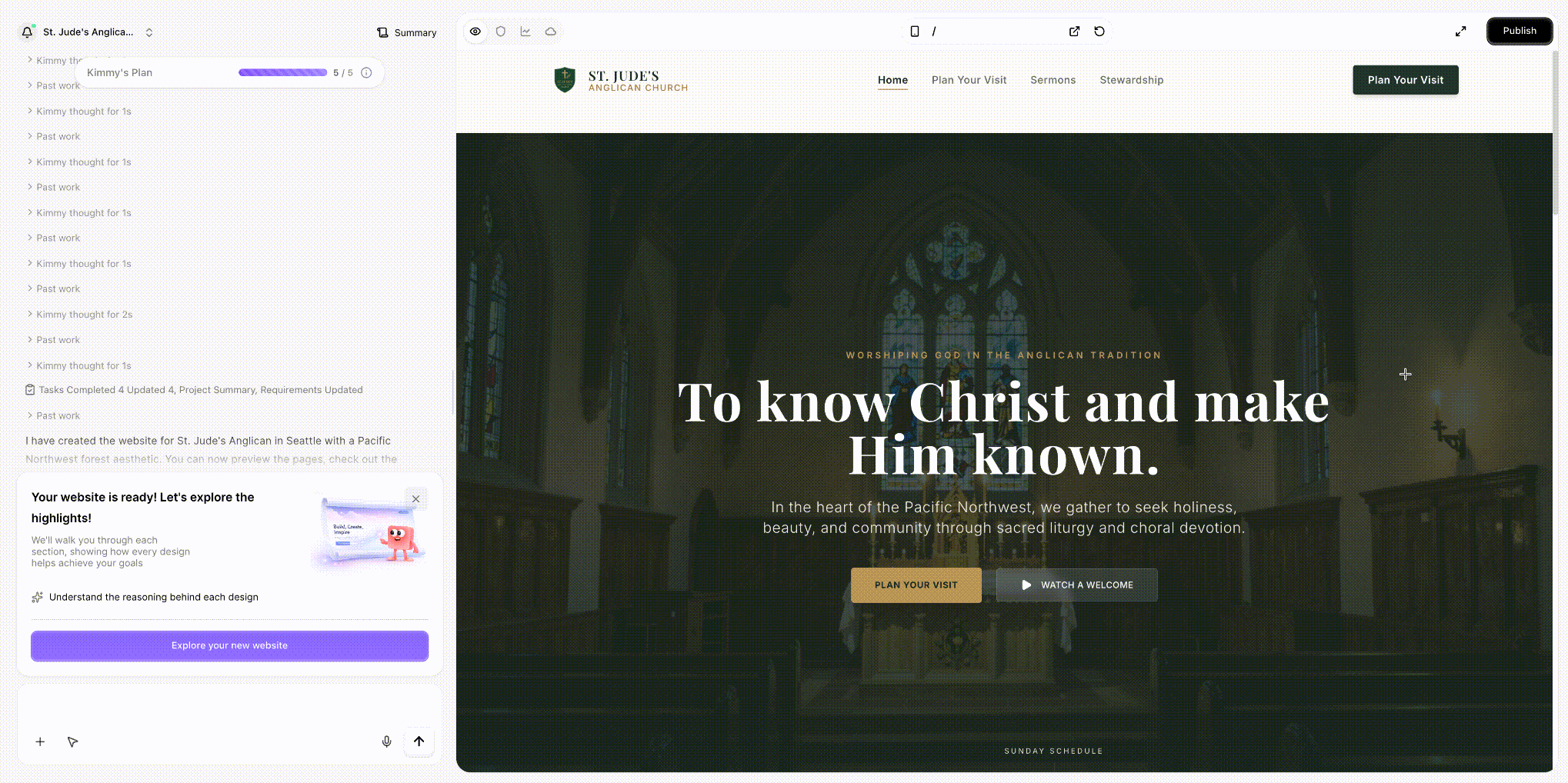
"Build me a church website for a 200-member traditional Anglican parish in the Pacific Northwest. Service times: 8am said Eucharist, 10am sung Eucharist, 5pm Evensong. Sermons by audio and text. A clear Plan Your Visit page for newcomers. Photography I'll upload. Subdued color palette. Online giving via Stripe, not pushy."
Phase 2: AI Assembly in Under a Minute
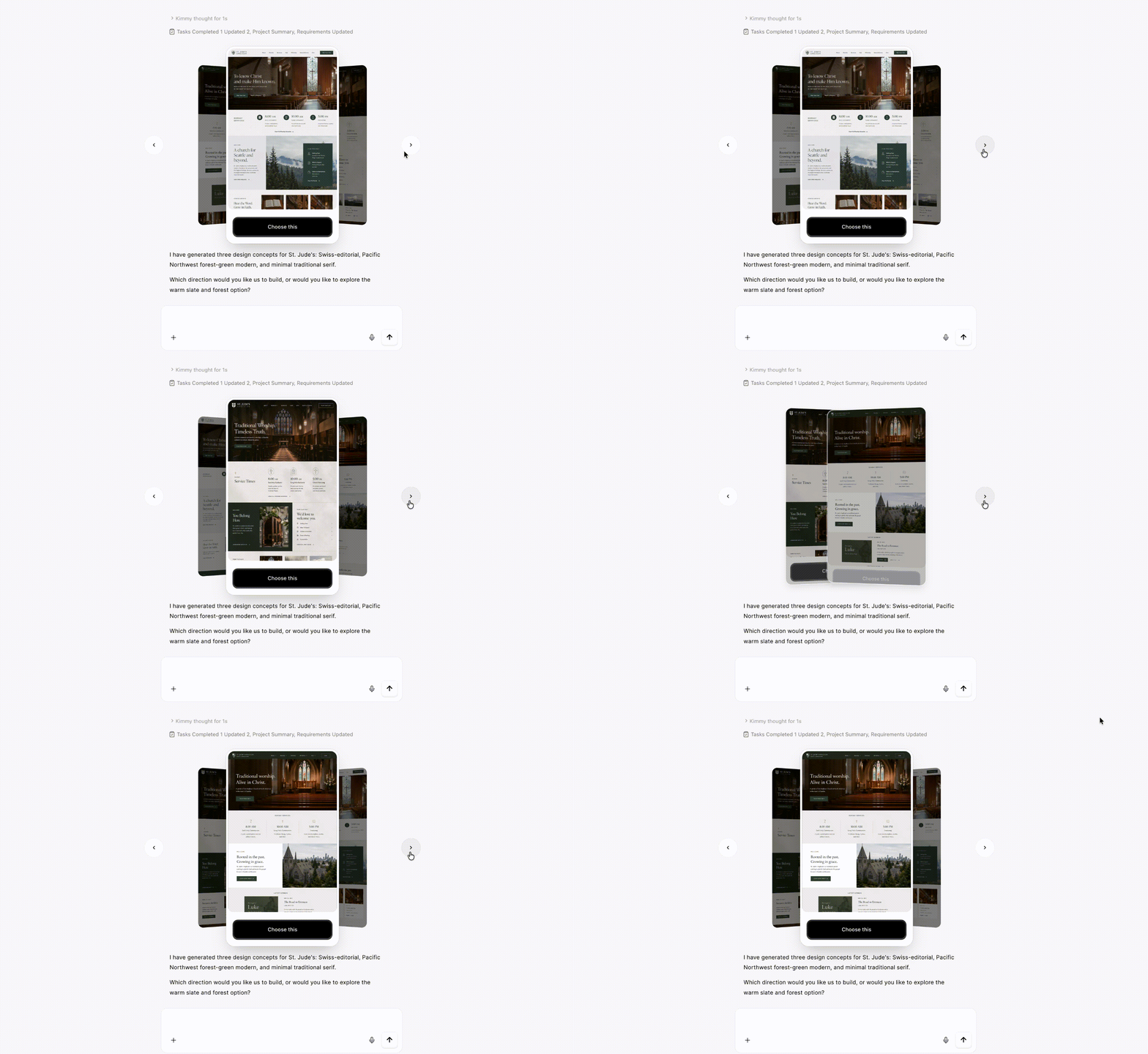
Wegic's GPT-powered engine writes the code from scratch. In under 60 seconds you get a fully responsive multi-page church site with service times in the header, a Plan Your Visit walk-through, a sermon library structure ready to fill, online giving wired to Stripe or Tithe.ly, mobile-first design that works on phones first, and SEO basics handled out of the box.
👇 Click below to start with Wegic
Phase 3: Edit by Conversation
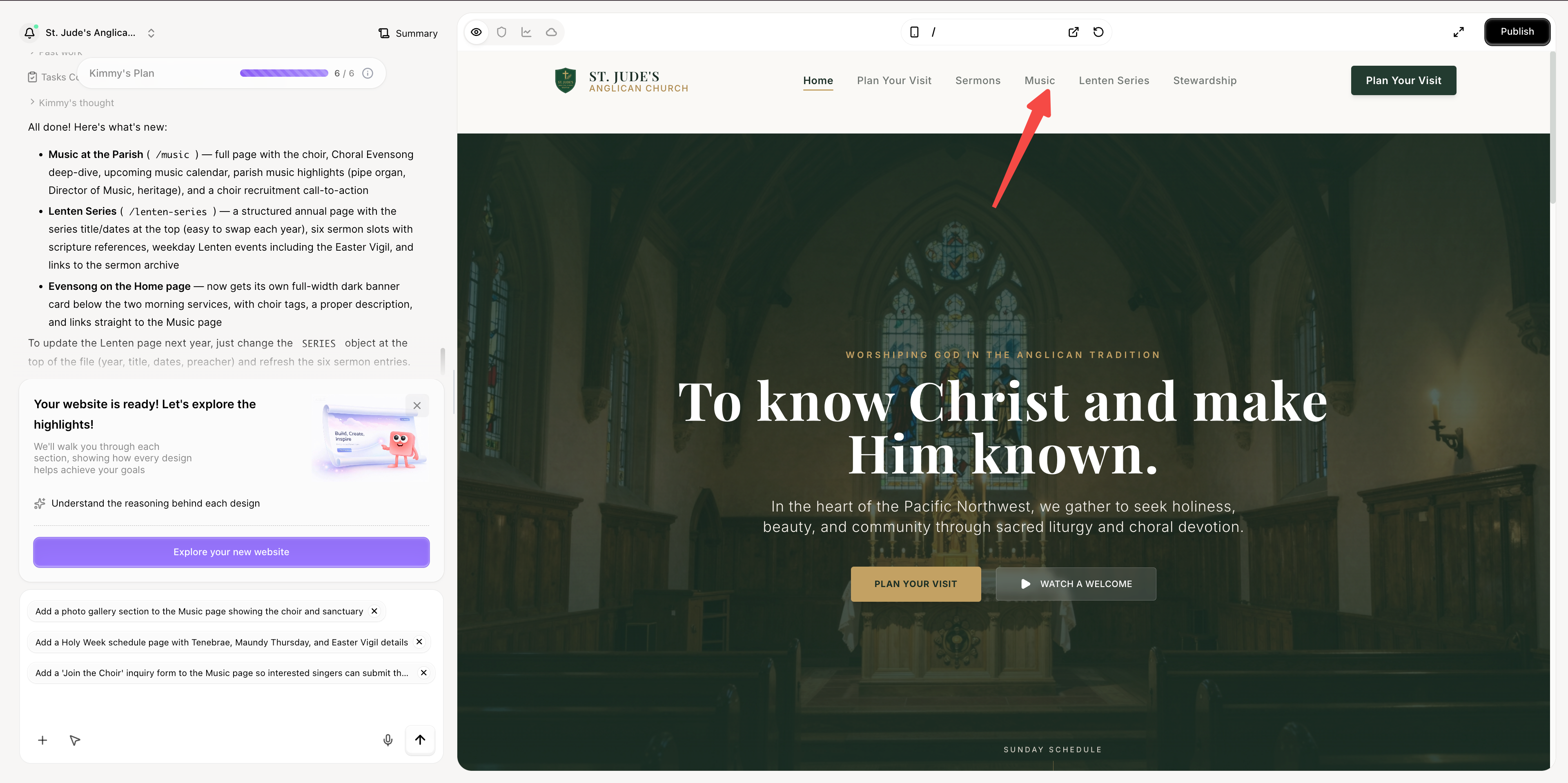
"Add a 'Music at the Parish' section to the navigation — we have a choir and want to showcase it. Make the Evensong service get equal prominence to the morning services. Add a Lenten series page that I can update each year."
Wegic proposes 2–3 design options with reasoning before applying. Mobile and desktop variants stay in sync. For deeper coverage of the conversational editing workflow, see the Wegic tutorial.
Phase 4: Publish with Hosting Included
Hit Publish. Hosting, custom domain, auto-generated
sitemap.xml, and SEO metadata are all bundled. For a side-by-side comparison of how Wegic stacks against template-based church builders on flexibility and design quality, see our in-depth review of 5 web design AI tools.Conclusion: Match the Pattern to Your Church, Not the Template to Your Building
The 12 church website examples in this guide work because each was matched to a specific congregation and tradition — not pulled from a generic megachurch template. Notre-Dame's reservation-first design works for Notre-Dame because Notre-Dame has 11 million annual visitors. St. Patrick's Mass-times-first design works because St. Patrick's congregation arrives for Mass. Brooklyn Tabernacle's diverse photography works because Brooklyn Tabernacle's congregation is diverse.
If you copy a pattern that doesn't match your church, the result is a website that looks like someone else's church. Match the pattern to your actual community, and the website becomes a clear, honest invitation — which is what good church homepage design is for.
For more design inspiration across other categories, see our broader website homepage examples guide and restaurant website examples. For technical foundations, the responsive website examples guide covers the mobile-first patterns most church sites get wrong, and the website navigation examples collection covers navigation patterns that translate directly to church sites.
FAQs
What information should every church website include?
Eight essentials, in priority order: (1) service times and address above the fold; (2) a clear "Plan Your Visit" page covering parking, dress, kids' programs, and what to expect; (3) a sermon archive with audio and ideally text; (4) staff and leadership with photos and short bios; (5) ministries organized by life stage or interest; (6) online giving that's findable but not pushy; (7) a contact form and clear phone number; (8) a "What we believe" or statement of faith page. Optional but increasingly expected: live-streaming, an events calendar, and a small church blog or newsletter.
What's the difference between a Catholic church website and an evangelical one?
A catholic church website centers on the sacramental calendar (Mass times, Confession, baptism preparation, RCIA) and serves an existing community more than it courts visitors. An evangelical church website tends to center on the visitor's first Sunday — "Plan Your Visit," what to expect, the senior pastor's introduction. The Catholic site's homepage should make Mass times and sacramental contact info obvious; the evangelical site's homepage should make the visitor path obvious. The two design philosophies are different and shouldn't be conflated.
How much should a church website cost?
It depends on size and complexity. A small church can launch a serviceable site with an AI-powered builder for under $300/year including hosting. A mid-sized church with multiple ministries, sermon archive, and online giving typically spends $1,500–$5,000/year on a managed solution. A megachurch with full media production, app integration, and custom design typically spends $20,000–$100,000+ on initial design, then ongoing development costs. The single biggest variable is whether the church needs a custom design or can use a thoughtful template.
What's the best website builder for a small church?
For small church website projects, three options dominate in 2026: AI-driven builders like Wegic generate a custom site from a description in under a minute; Squarespace and Wix have polished church templates but require manual layout work; and church-specific builders (Tithe.ly Sites, The Church Co, Subsplash) bundle giving, livestream, and church management. The best choice depends on whether you want design flexibility (Wegic, Squarespace), bundled ministry tools (Subsplash, Tithe.ly), or rock-bottom cost (Wegic's free tier).
How do I add online giving to my church website?
Three main paths: (1) Stripe or PayPal direct integration — most flexible, but you're responsible for the giving page design; (2) church-specific giving platforms like Tithe.ly, Pushpay, or Subsplash Giving — built for churches, handle recurring giving, donor management, and tax receipts; (3) embedded widgets from your church management software (Planning Center, Breeze) if you already use one. For most churches, a Tithe.ly or Stripe-based solution offers the best balance of ease and professionalism.
Should small churches even bother with a website?
Yes — more so than ever. The smaller and less famous your church is, the more important the website becomes, because it's how prospective visitors find you in the first place. A 50-member church without a website is invisible to anyone moving into the neighborhood. A 50-member church with a clean, honest website that surfaces service times and a phone number is findable. The website doesn't need to be elaborate. It needs to exist and answer the basics.
What's a good church homepage layout?
A simple, repeatable church homepage design structure: (1) header with logo, primary nav, and persistent service times; (2) hero with a single clear CTA (usually "Plan Your Visit"); (3) service schedule strip below the hero; (4) latest sermon preview; (5) 3–4 ministry cards (Kids, Students, Adults, Outreach or similar); (6) upcoming events strip; (7) statement of faith or about-the-church block; (8) footer with address, contact, and social links. This structure works for evangelical, Catholic, and historic churches with minor reshuffling of priorities.
Are church website templates worth using?
It depends. Church website templates from Tithe.ly, Subsplash, or Squarespace are a fast and affordable starting point — but they tend to make every church look like every other church using the same template. If your church has a distinctive identity (a Catholic parish with Latin Mass, a multi-ethnic Pentecostal congregation, a contemporary plant), a template can flatten that identity. AI-generated sites from tools like Wegic avoid template sameness because each site is generated from your specific description, not selected from a pre-baked library.